Sunday, February 21, 2016

Trees Have Social Networks, Too


“When I say, ‘Trees suckle their children,’ everyone knows immediately what I mean.” PETER WOHLLEBEN Credit Gordon Welters for The New York Times
 HÜMMEL, Germany — IN the deep stillness of a forest in winter, the sound of footsteps on a carpet of leaves died away. Peter Wohlleben had found what he was looking for: a pair of towering beeches. “These trees are friends,” he said, craning his neck to look at the leafless crowns, black against a gray sky. “You see how the thick branches point away from each other? That’s so they don’t block their buddy’s light.”
Before moving on to an elderly beech to show how trees, like people, wrinkle as they age, he added, “Sometimes, pairs like this are so interconnected at the roots that when one tree dies, the other one dies, too.”
Mr. Wohlleben, 51, is a very tall career forest ranger who, with his ramrod posture and muted green uniform, looks a little like one of the sturdy beeches in the woods he cares for. Yet he is lately something of a sensation as a writer in Germany, a place where the forest has long played an outsize role in the cultural consciousness, in places like fairy tales, 20th-century philosophy, Nazi ideology and the birth of the modern environmental movement.
Mr. Wohlleben traces his love of the forest to his early childhood, where he raised spiders and turtles. In high school, teachers painted a dire picture of the world’s ecological future, and he decided it was his mission to help. Credit Gordon Welters for The New York Times
After the publication in May of Mr. Wohlleben’s book, a surprise hit titled “The Hidden Life of Trees: What They Feel, How They Communicate — Discoveries From a Secret World,” the German forest is back in the spotlight. Since it first topped best-seller lists last year, Mr. Wohlleben has been spending more time on the media trail and less on the forest variety, making the case for a popular reimagination of trees, which, he says, contemporary society tends to look at as “organic robots” designed to produce oxygen and wood.

Presenting scientific research and his own observations in highly anthropomorphic terms, the matter-of-fact Mr. Wohlleben has delighted readers and talk-show audiences alike with the news — long known to biologists — that trees in the forest are social beings. They can count, learn and remember; nurse sick neighbors; warn each other of danger by sending electrical signals across a fungal network known as the “Wood Wide Web”; and, for reasons unknown, keep the ancient stumps of long-felled companions alive for centuries by feeding them a sugar solution through their roots.

“With his book, he changed the way I look at the forest forever,” Markus Lanz, a popular talk show host, said in an email. “Every time I walk through a beautiful woods, I think about it.”

Though duly impressed with Mr. Wohlleben’s ability to capture the public’s attention, some German biologists question his use of words, like “talk” rather than the more standard “communicate,” to describe what goes on between trees in the forest.

But this, says Mr. Wohlleben, who invites readers to imagine what a tree might feel when its bark tears (“Ouch!”), is exactly the point. “I use a very human language,” he explained. “Scientific language removes all the emotion, and people don’t understand it anymore. When I say, ‘Trees suckle their children,’ everyone knows immediately what I mean.”
Still No. 1 on the Spiegel best-seller list for nonfiction, “Hidden Life” has sold 320,000 copies and has been optioned for translation in 19 countries (Canada’s Greystone Books will publish an English version in September). “It’s one of the biggest successes of the year,” said Denis Scheck, a German literary critic who praised the humble narrative style and the book’s ability to awaken in readers an intense, childlike curiosity about the workings of the world.

The popularity of “The Hidden Life of Trees,” Mr. Scheck added, says less about Germany than it does about modern life. People who spend most of their time in front of computers want to read about nature. “Germans are reputed to have a special relationship with the forest, but it’s kind of a cliché,” Mr. Scheck said. “Yes, there’s Hansel and Gretel, and, sure, if your marriage fails, you go for a long hike in the woods. But I don’t think Germans love their forest more than Swedes or Norwegians or Finns.”

Mr. Wohlleben traces his own love of the forest to his early childhood. Growing up in the 1960s and ’70s in Bonn, then the West German capital, he raised spiders and turtles, and liked playing outside more than any of his three siblings did. In high school, a generation of young, left-leaning teachers painted a dire picture of the world’s ecological future, and he decided it was his mission to help.

He studied forestry, and began working for the state forestry administration in Rhineland-Palatinate in 1987. Later, as a young forester in charge of a 3,000-odd acre woodlot in the Eifel region, about an hour outside Cologne, he felled old trees and sprayed logs with insecticides. But he did not feel good about it: “I thought, ‘What am I doing? I’m making everything kaput.’ ”

Reading up on the behavior of trees — a topic he learned little about in forestry school — he found that, in nature, trees operate less like individuals and more as communal beings. Working together in networks and sharing resources, they increase their resistance.

By artificially spacing out trees, the plantation forests that make up most of Germany’s woods ensure that trees get more sunlight and grow faster. But, naturalists say, creating too much space between trees can disconnect them from their networks, stymieing some of their inborn resilience mechanisms.

Intrigued, Mr. Wohlleben began investigating alternate approaches to forestry. Visiting a handful of private forests in Switzerland and Germany, he was impressed. “They had really thick, old trees,” he said. “They treated their forest much more lovingly, and the wood they produced was more valuable. In one forest, they said, when they wanted to buy a car, they cut two trees. For us, at the time, two trees would buy you a pizza.”

Back in the Eifel in 2002, Mr. Wohlleben set aside a section of “burial woods,” where people could bury cremated loved ones under 200-year-old trees with a plaque bearing their names, bringing in revenue without harvesting any wood. The project was financially successful. But, Mr. Wohlleben said, his bosses were unhappy with his unorthodox activities. He wanted to go further — for example, replacing heavy logging machinery, which damages forest soil, with horses — but could not get permission.

After a decade of struggling with his higher-ups, he decided to quit. “I consulted with my family first,” said Mr. Wohlleben, who is married and has two children. Though it meant giving up the ironclad security of employment as a German civil servant, “I just thought, ‘I cannot do this the rest of my life.’” The family planned to emigrate to Sweden. But it turned out that Mr. Wohlleben had won over the forest’s municipal owners.

So, 10 years ago, the municipality took a chance. It ended its contract with the state forestry administration, and hired Mr. Wohlleben directly. He brought in horses, eliminated insecticides and began experimenting with letting the woods grow wilder. Within two years, the forest went from loss to profit, in part by eliminating expensive machinery and chemicals.

Despite his successes, in 2009 Mr. Wohlleben started having panic attacks. “I kept thinking, ‘Ah! You only have 20 years, and you still have to accomplish this, and this, and that.’” He began therapy, to treat burnout and depression. It helped. “I learned to be happy about what I’ve done so far,” he said. “With a forest, you have to think in terms of 200 or 300 years. I learned to accept that I can’t do everything. Nobody can.” He wanted to write “The Hidden Life of Trees” to show laypeople how great trees are.

Stopping to consider a tree that rose up straight then curved like a question mark, Mr. Wohlleben said, however, that it was the untrained perspective of visitors he took on forest tours years ago to which he owed much insight.

“For a forester, this tree is ugly, because it is crooked, which means you can’t get very much money for the wood,” he said. “It really surprised me, walking through the forest, when people called a tree like this one beautiful. They said, ‘My life hasn’t always run in a straight line, either.’ And I began to see things with new eyes.”

http://www.nytimes.com/2016/01/30/world/europe/german-forest-ranger-finds-that-trees-have-social-networks-too.html?_r=0 

Monday, February 15, 2016

Street Trees Really Do Make People Healthier


Jason G. Goldman

It’s easy enough to claim that being in nature makes people feel better. It certainly feels like it’s true. A weekend in the mountains, or even a few hours in a park after a long day at work, truly feels like it is somehow restorative.

There are some good reasons to believe that green space could have a causal relationship with health and happiness. For one thing, trees scrub pollution from the skies, allowing those nearby to breathe cleaner air. Exposure to nature has also been linked with reduced blood pressure and stress, and it seems to motivate folks to become more active and less sedentary. Then there’s the Japanese practice of shinrinyoku, or “forest bathing.” The Japanese believe that what essentially amounts to a nature walk promotes human health and wellbeing. Plants are also part of a complex food web that, together, provides things critical to our survival like oxygen to breathe, fresh water to drink, and food to eat. Even if all these things are true – and they probably are – that still doesn’t mean that it’s nature, per se, that’s having the apparent health benefit.

To make that claim we need real, quantifiable data. That’s where University of Chicago psychology graduate student Omid Kardan and University of Chicago professor Marc G. Berman come in. They and their colleagues looked to Toronto, Canada, a city for which there is plenty of satellite imagery (which allows them to measure green spaces) and self-reported health information through the Ontario Health Study. By using a set of common statistical techniques, the researchers were able to really see whether there’s anything to the idea that greenery makes people healthier.

But it wasn’t green spaces in general they were interested in; it was trees in particular. By leaving lawns and bushes out, the researchers hoped to zero in on what they thought was “potentially the most important component for having beneficial effects.” First, they took data on trees from two databases maintained by the city of Toronto: “Street Tree General Data” and “Forest and Land Cover.” Together, those databases provided information on street trees as well as those in parks and backyards. They chose Toronto in part to rule out the effects of health insurance; unlike in the US, Canadians are guaranteed universal publically funded healthcare, regardless of employment status or income level. Still, despite equal access, not all Canadians choose to avail themselves of healthcare in equal ways. Indeed, those with lower incomes and fewer years of schooling tend to see doctors less often, which is why the researchers made note of that sort of demographic data.

They found that those who live in areas with more street trees reported better health perception than those in neighborhoods with fewer trees. Regardless of their actual health, they felt they were healthier. But it turns out they were actually healthier too: they suffered from fewer cardio-metabolic conditions.

But that’s not all. To really drive the point home, Kardan reduced the findings to cold, hard cash.

His team found that by planting 10 more trees per city block, Toronto could improve health perception as much as if every household on that same block earned $10,000 more every year, or magically became seven years younger.

The results were even more striking for actual health. Planting just 11 more trees per city block would reduce cardio-metabolic conditions the same extent as if everybody living on that block earned $20,000 more each year or somehow became 1.4 years younger.

So what’s the secret? Kardan doesn’t know, and his study isn’t explicitly designed to get at the underlying mechanism. But a close look at the data offers up a suggestion. It wasn’t proximity to trees in a neighborhood that was the most important variable, but the number of trees on the streets. That suggests that it’s not necessarily that the trees are themselves providing important services (they do that, though that might not be what accounts for these health effects). Instead, it could be something as simple as peoples’ ability to literally see trees, and the most common place for most people to see trees is on the street. It’s also possible that street trees are disproportionately responsible for capturing street pollution, and that could be driving the team’s findings.

Maintaining a street tree for a year costs between $30 and $500, depending on where it is. In other words, planting ten or eleven trees per city block would be far cheaper than paying everyone $10,000-20,000 more each year. That should be good news for city planners.

Sunday, January 31, 2016

Interlocking Pavers - A Cost-Effective, Long-Term Solution in Cold Climates

When the city of North Bay, Ontario, explored the use of interlocking concrete pavers for its heavily trafficked downtown city center in the early 1980s, officials of this city of 54,000 wanted to know they’d be getting the most for their money. Not only did the resulting installation meet aesthetic and functional goals, it has since become a model of low-maintenance cost savings that has proved durable well beyond its projected lifespan of 20 years.
At the time of its completion in 1983, the $3 million, 150,000 sf (13,900 m²) Main Street project, which included roadway and sidewalks constructed on the full width of the road allowance, was hailed for its aesthetic contribution to a revitalized downtown business and retail district. When surveyed eight and 16 years later, the pavement was found to be performing exceptionally well under high traffic and extreme weather conditions, with little evidence of distress, despite minimal maintenance needed. In fact, after 12 years, a city official confirmed that there had been no maintenance at all. In addition, a 1999 life cycle cost analysis that compared the concrete paver installation with a local control section of hot-mix asphalt pavement found a difference of about $76,000/lane-km in maintenance costs favoring the concrete pavers.
Thirty-two years later, the installation is still performing, though finally ready for replacement, says Adam Lacombe, P. Eng, North Bay senior capital program engineer. The city is budgeting for a paver replacement to begin in 2017 or 2018. “Main Street has always been the centerpiece of the city, and the [pavers] set it off,” he says. “We are [considering] replacing them for their aesthetic quality and lifespan.”
Extreme Applications
The Main Street project was conceived at a time when the city of North Bay was planning to update its central business district with a more people-friendly scale and unified appearance. As part of the transformation, approximately 50 percent of the on-street parking was recommended for removal. In its place, designers envisioned wider sidewalks, boulevard areas and the addition of trees and planting areas, new benches, underground wiring and new streetlights.
Aiming to attract shoppers to a refreshed retail destination at a time when traditional Main Street businesses were losing business to shopping malls, North Bay’s Engineering and Public Works Departments gave interlocking concrete pavers first consideration in part for their potential to create an aesthetic identity for the district. But another major goal was to find a pavement that could handle an expected traffic volume of 8,000 vehicles per day (5 percent delivery trucks and buses), as well as snow removal and harsh weather conditions.
In North Bay, temperatures can range from −40 C in winter to 35 C in summer, and punishing freeze-thaw cycles occur throughout the winter months, with frost depths of up to 8 ft (2.4 m). The Main Street roadway would be subject to approximately 300 tons of salt annually, as well as the regular impact of the carbide steel blades used on snow-removing graders, slushers and plows.
At the time of the project’s conception, interlocking concrete pavers were already in use in high-load, harsh-weather projects around the world, and were just beginning to gain wider interest for heavy-use projects in North America. Just one year before the North Bay Main Street pavement was installed, 610,000 sf (56,700 m²) of interlocking concrete pavement was used in what is now called the Pier IX Terminal, in Newport News, VA. This facility handles ground storage of coal, so the pavers are subject to high loads from coal storage piles and abrasive loads from steel-tracked bulldozers. This provided an example of durability in an industrial setting.
North Bay officials had some experience with concrete pavers, which had successfully performed in an area around city hall for five winters under de-icing salts. But that area was not subject to vehicular traffic, so additional evidence was sought to prove the material and its installation could withstand projected traffic load and environmental conditions long-term.
A seminar that brought in experts from Australia, England and the Netherlands demonstrated to North Bay stakeholders how pavers had performed successfully under extreme loads and weather conditions in container ports, airports and roadways. Presenters offered compelling evidence that, when designed and executed correctly, the installation would withstand the rigors of a heavily trafficked Northern Ontario Main Street.

Best Practices Defined

The manufacturers, designers, engineers and installers involved in the Main Street installation set their sights on creating a state-of-the-art model showcase for what was recognized as a high-profile project. The pavers were manufactured to resist abrasion and freeze-thaw conditions, meet compressive strength and absorption standards, and were subject to a salt immersion test. Installation included a compacted subbase and base, edge restraints in the form of cast-in-place concrete curbs, concrete collars around utility structures such as manholes to offer a stationary restraint for the pavers, a herringbone pattern to provide the greatest degree of interlock (except in the crosswalks, which use a running bond pattern), and a slight crown in the roadway to allow for natural settling and drainage after construction. Sub-drains were utilized in some locations and surface water was designed to flow to catch basins and storm sewers.
During construction, installers performed regular density checks of the base with a nuclear density gauge to achieve the specified level of compaction that is critical to long-term performance. Nearing the end of installation, a plate compactor was used to force bedding sand into the joints and to facilitate the process of paver interlock, which in turn enables the transfer of vehicular load from paver to paver.
From today’s perspective, the North Bay Main Street project helped define best practices for interlocking concrete pavement manufacture and installation, some of which later became ASTM and CSA standards, including those for compressive strength, freeze-thaw durability and dimensional durability, and remain in use today.

Test of Durability

At eight years post-construction, an engineering consultancy performed a detailed condition survey and non-destructive deflection testing of the Main Street pavement. The survey found that about 4 percent of the approximately 57,000 sf of pavement surveyed had depressions concentrated in an area that had been subject to improper repair of the base when reinstalled after utility repairs. Another section that showed spalling resulted from incomplete joint filling and subsequently pavers losing interlock. Aside from this, the report concluded that the pavements provided “excellent performance…surface deformation occurs in less than 1.5 percent of the pavement areas surveyed,” and that the pavers were in “very good to excellent condition.”
Sixteen years after completion, in 1999, a geotechnical engineering consultant performed another condition survey that included a comparison with a local control section of asphalt pavement. It concluded that the interlocking concrete pavement showed little evidence of distress, with pavement condition indexes (PCI) for tested sections averaging 70 on a scale of 0 to 100 (with 100 showing no distress).
At 20 years, North Bay Public Works confirmed that the pavement was expected to be serviceable for another 15 to 20 years with only minimal maintenance anticipated.

A Cost-Effective Option

As part of the 1999 survey, a 40-year model was used for a life cycle cost analysis comparing the pavers and an asphalt street model that concluded rehabilitation of the pavers would be required at Year 21 in order to maintain a pavement PCI of 60. For the asphalt pavement, rehabilitation would correspond to years 18, 27 and 36 to maintain a PCI of 60.
At a 4 percent discount rate (corresponding to a secure investment of 6 percent and inflation of 2 percent), interlocking concrete pavements were shown to be more cost-effective than asphalt pavements. The study did not reflect costs to the public in downtime from routine maintenance and repairs. Interlocking concrete pavers can have a significant benefit in terms of reduction of these user delay costs because traffic can be restored very quickly after repair; also, less maintenance downtime is required over the pavement’s lifespan.
Since 1983, North Bay has continued using interlocking concrete pavers in public sidewalks, boulevards, its train station and lengthy promenades along its award-winning Lake Nipissing Waterfront Park. In 2010, it added a one-block section of pavers in a roadway that complements nearby Main Street and sets off a roadway island park. Likewise, cities across the United States and Canada have since chosen pavers for a variety of low- and high-impact projects, taking advantage of their endurance, aesthetic qualities and green attributes, more recently including permeable installations that aid in stormwater management.
The details of North Bay’s Main Street pavement rehabilitation are still to be determined as the city works on a new land use and urban design plan, says Mr. Lacombe. A rough estimate for replacing the pavement, including design and construction, is currently $2.4 million, he says.
North Bay faces the same decisions as hundreds of cities across North America: how to replace an aging downtown roadway in a way that’s economical in the short and long term, while taking into account aesthetic and environmental considerations, and the needs of stakeholders. The Main Street project offers strong evidence that interlocking concrete pavers are suitable for high-impact applications, and can be the most cost-effective pavement solution when considering total cost of ownership over the long term.
http://interlockdesign.org/Taking-the-Long-View

Tuesday, January 12, 2016

Hypoallergenic Parks: Coming soon?


Hypoallergenic parks: Coming soon?
Garcia Lorca Park, one of the urban green spaces studied by Cariñanos Gonzalez and her team. Credit: Manuel Casares-Porcel.
Ah-choo! If you suffer from seasonal allergies, you're probably sick of this refrain. And you're not alone. Millions of Americans suffer from seasonal allergies. Moreover, there are allergy sufferers around the world echoing this allergy anthem.

Carinanos' interest in studying allergies started early. She and her seven brothers and sisters all suffer from seasonal allergies, a trait they inherited from their father. "Since I was young, I became an expert in everything associated with this disease, its symptoms, how to prevent it, avoid it, or treat it." Carinanos said. Despite this early interest in plants and allergies, she originally planned to attend veterinary school. But she says, "I think that my destiny was written, and I was admitted to the Faculty of Biology of the University of Cordoba."

Now she is an expert in the conservation and management of plants and wildlife. With her team, she studies how the plants in urban green spaces affect the air quality of that area. Then they look at how the air quality affects human health. Her team specifically studies the city of Granada, Spain. This city's climate and layout is like that of many cities in the Mediterranean area, which has the highest occurrence of pollen allergies in the world. The researchers hope their efforts will lead to fantastic urban green spaces that don't cause allergic reactions for 30% of the city's population.
Hypoallergenic parks: Coming soon?
Cypresses in the historical neighborhood Albayzin, in Granada. You can see how symbolic (and common) these trees are to the region. Credit: Paloma Cariñanos Gonzalez.
To start, Carinanos and her team began by classifying the trees in Granada's ten largest green spaces. They grouped the trees into three categories. Then they recorded the type of pollination, the length of the pollination period, and the potential for causing allergies for each tree. The researchers used all of this information to calculate if the green space was negatively affecting air quality and causing allergies.To start, Carinanos and her team began by classifying the trees in Granada's ten largest green spaces. They grouped the trees into three categories. Then they recorded the type of pollination, the length of the pollination period, and the potential for causing allergies for each tree. The researchers used all of this information to calculate if the green space was negatively affecting air quality and causing allergies.

 What the researchers found was surprising. Many of the most common trees in Granada were among the trees causing unhealthy or hazardous air quality. Carinanos also found it surprising that the design of these green spaces thought about landscaping, climate, and fashion criteria, but didn't think about pollen problems.

From their findings, the researchers have made suggestions for planning future green spaces. Their recommendations are to make sure that all citizens can enjoy the great outdoors with clear eyes and dry noses. Carinanos says that in the future, urban green spaces "will become 'comfort islands' inside 'urban heat islands.'" She wants to make sure these comfort islands are "for all citizens without exception."

This research may be just what allergy sufferers have been waiting for, and it's good news for others, too. Carefully selecting trees for green spaces may help combat climate change. Increasing the variety of trees in green spaces can both decrease allergies and increase the urban vegetation's ability to clean pollutants out of the air.

Carinanos and her team stress that their research is a tool for planning and prevention. They hope that other cities will be able to use their methods to prevent high allergen levels. Doing so may help growing city populations live more comfortably and with fewer health issues. The researchers ultimately want to ensure that urban green spaces play a role in keeping both the climate and people healthy.

http://phys.org/news/2015-08-hypoallergenic.html

Tuesday, January 5, 2016

Guerrilla Grafters Secretly Graft Fruit-Bearing Branches onto San Francisco Trees


Mark Boyer

We’ve heard of guerrilla gardening, and we’ve heard of grafting plants — but guerrilla grafting? That’s new to us. For the past two years, a group that calls themselves Guerrilla Grafters have been secretly grafting fruit-bearing scions onto ornamental, non-fruiting trees in San Francisco. City officials contend that Guerrilla Grafters are breaking the law, but their actions have been celebrated by proponents of urban agriculture. And they have been included in the US pavilion’s Spontaneous Interventions exhibit at the Venice Biennale.

The streets of San Francisco are lined with pear, plum and apple trees, but out of fear that the fruit would make a mess and attract rodents, the city intentionally planted sterile trees that don’t bear fruit. By grafting fruit-bearing branches on those trees, Guerrilla Grafters make fruit free and accessible to anyone who picks it. The group was started by Tara Hui, who started grafting fruit-bearing branches onto city trees a few years ago.


To graft a branch onto a fruit tree, all you have to do is make a slit with a knife in a branch on the host tree; insert a branch from a fruit-bearing tree, and secure it with tape. “Once it heals, it connects,” Hui told the LA Times. “Basically the branch becomes part of the tree.” Guerrilla Grafters use color-coded electrical tape to mark their handiwork, but they won’t disclose the location of their interventions to the press out of fear that the city will remove them.

With “undoing civilization one branch at a time” as their motto, Guerrilla Grafters consider what they do to be a radical act — and it is. Although it doesn’t solve problems of food scarcity, it’s a symbolic move towards making fresh food free and accessible to all. As the group explains, it’s one step closer to creating “a habitat that sustains us.”

http://inhabitat.com/guerrilla-grafters-secretly-graft-fruit-bearing-branches-onto-san-francisco-trees/

Monday, December 28, 2015

The Privatization of Cities' Public Spaces is Escalating. It is time to take a stand.


The Granary Square ‘Pops’ in London’s King’s Cross is one of the largest open-air spaces in Europe. Photograph: John Sturrock for the Guardian


I was recently sent a link to a YouTube video entitled We Too, in which a trespasser sneaks into the under-construction, 34-story Lexicon skyscraper near the Silicon Roundabout in London, and pitches a tent on the top floor.

In the video, after a good night’s sleep, the interloper unzips the front flap of the shelter and steps into the early-morning air. The city unfolds before him in a stunning vista, suggesting the view that future occupants of the skyscraper will enjoy – or, more likely in London, the view that international investors will use as a selling point when they put the flat back on the market after a few years of not living in it.

Later that day, I received another link to Craigslist where the Lexicon lurker, as I came to call him, had placed an ad for a “highly affordable luxury penthouse in Islington”, illustrated with a crisp photo of his tent overlooking the city. The punchline of this performance – that “we too sleep in penthouses” – was a playful way of re-framing the most pressing concern in the neoliberal city: who is it actually for?

The geographer David Harvey once wrote that “the freedom to make and remake our cities and ourselves is … one of the most precious yet most neglected of our human rights”. Generations of urban theorists, from Lewis Mumford to Jane Jacobs to Doreen Massey, have suggested that the place where cities get “remade” is in the public rather than private sphere. Part of the problem, then, with privately owned public spaces (“Pops”) – open-air squares, gardens and parks that look public but are not – is that the rights of the citizens using them are severely hemmed in. Although this issue might be academic while we’re eating our lunch on a private park bench, the consequences of multiplying and expanding Pops affects everything from our personal psyche to our ability to protest.

Let me offer two examples from other cities. I am originally from Los Angeles and recently went back to visit. When I asked an old friend where you could find the public space in LA, his response was: “What, to buy?” This sounds like sarcasm, but Los Angeles is a city infamous for slaying public space and public transportation. My friend clarified his genuine confusion later when he sent me a Los Angeles Times article about how the city had begun to sell slivers of pavement on the private market intended for crafty entrepreneurs looking for ad space.

So there’s one model – and here’s another. A few years back, I was in Phnom Penh, Cambodia, and I asked a colleague if we could go somewhere photogenic. I was taken to Vann Molyvann’s 1964 National Stadium, a Brutalist behemoth built in anticipation of the Southeast Asian Peninsular Games in 1963.
When we arrived, the place was filled with hundreds of people, none that I could see in any sort of official capacity. Some were conducting open-air aerobics classes, others were selling barbecued corn from rolling carts, a few people were air-drying laundry and many were just milling about on foot or scooters. I even met a child taking a bath in a bucket, who tried to douse me. Nothing was locked. I went in and out of areas at will, including the vast indoor stadium, which was unoccupied except for a few kids smoking a joint. There was an intense energy in the air that came from a little sprinkling of chaos – a feeling that anything could happen here.

‘The place was filled with people, none in any kind of official capacity’ ... Phnom Penh’s National Stadium offers a different model of public space. Photograph: Bradley L Garrett 
It was then I realized that one problem with Pops is they lack that kind of energy. They feel too monitored, too controlled, to allow this communal activity to simply unfold. London, and many other cities, are failing miserably to enable diversity in people’s engagement with such spaces.

In 2012, the Guardian ran a campaign to crowdsource data about Pops in Britain. The project, though incomplete, suggested a clear pattern. Having begun to be built in the 1980s (unsurprisingly), Pops around the country increased steadily in number through the 2000s, and also grew in size. This includes the estate of More London, a 13-acre expanse stretching down the Thames’s Southbank. It was completed in 2003 and sold off in 2013 to Kuwaiti property company St Martins for £1.7bn, in one of the largest commercial property deals in British history.

In the process, the transformation of the areas outside City Hall into a Pops means it is no longer possible to protest outside the headquarters of the mayor and the Greater London Authority (GLA). Or to take photos, apparently: when I was filming with Channel 4 there last year, we were swiftly removed from the property. This is nothing new. In 2010, during a London Assembly planning and housing committee meeting, Jenny Jones, from the Green party, said: “It has taken us eight years to negotiate with More London so that we politicians can do a TV interview outside our own building.”

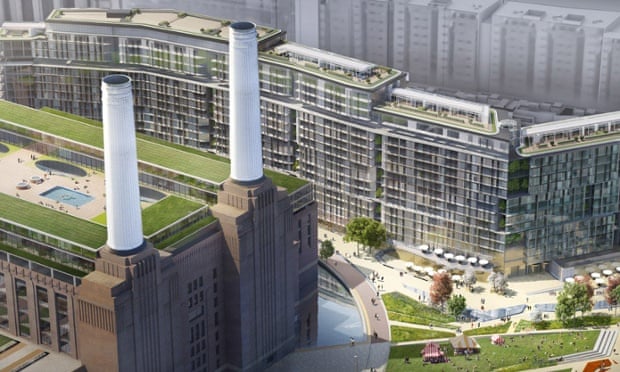
Despite multiple objections from politicians and notwithstanding Boris Johnson’s 2011 Manifesto for Public Space, the construction of Pops such as More London is continuing to escalate and expand, including nine acres planned in Tower Hamlets, a vast patch outside the Battersea Power Station development, and open space and parks at Woodberry Down near Manor House, where I was chased around for taking photos a few months ago. Given how all these developments seem to contradict stated city authority goals to increase public space that is actually publicly owned, one could be forgiven for thinking that the GLA is not actually in control of development in London.

The proposed redevelopment of Battersea Power Station, which will be a privately owned public space.
The proposed redevelopment of Battersea Power Station will include yet more privately owned public space. Photograph: LDA Design

So what is it we expect to happen in public space? In 2008, geographer Ash Amin wrote that “public spaces marked by the unfettered circulation of bodies [produce] new rhythms from the many relational possibilities”. I experienced elements of this in the Phnom Penh National Stadium. But, when space is controlled, and especially when the public is unclear about what the legal or acceptable boundaries of activity are, we tend to police ourselves, to monitor our behaviour and to limit our interactions, especially after embarrassing confrontations with security.

Property owners are perfectly aware of this and prey on those sensibilities. The new King’s Cross development at Granary Square is one of the largest open-air spaces in Europe – about the same size as Trafalgar Square. Unlike Trafalgar Square, it is also a Pops. Photographer Nicholas Goodden set up a tripod there recently to take a photo, and was immediately asked by security whether he had a permit to do so. When he said he did not, he was ordered to move across the canal to get his image. In other words, he was kicked out of “public” space. This would not have happened to a photojournalist in Trafalgar Square, which is owned by the Crown and managed by the Greater London Authority.

Moreover, an encounter with security like this may make you wary and cause you to confine your behaviour to a narrow range so as to avoid confrontation. The psychological effects of this sort of self-policing were written about by Michel Foucault: “He who is subjected to a field of visibility, and who knows it, assumes responsibility for the constraints of power; he makes them play spontaneously upon himself; he inscribes in himself the power relation in which he simultaneously plays both roles; he becomes the principle of his own subjection.”

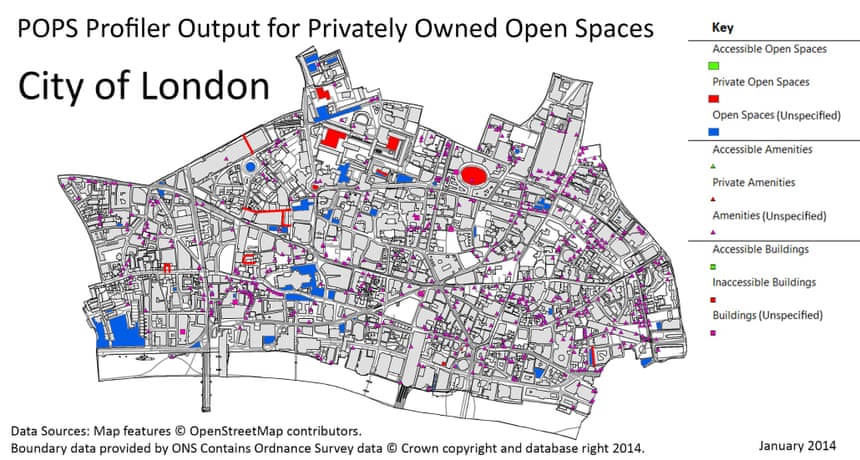
Oliver Dawkins's Pops Profiler.
The Pops Profiler, by Casa student Oliver Dawkins, shows privately owned public space in London’s Square Mile
Geographer Don Mitchell suggests that what public space provides in a city under surveillance are small islands of freedom surrounded by Foucault’s “carceral archipelago” – the surveilled city. Herein lies a crucial question: what happens when our small islands of freedom become indistinguishable from the rest of the city? Sociologist Richard Sennett suggests that private public spaces are “dead public spaces” because the essence of conviviality, spontaneity, encounter and yes, that little sprinkle of chaos, have been stripped out. The spaces are not rendered dead because they aren’t enjoyable – I myself enjoy lounging on the steps near the canal at Granary Square – but dead because the potential range of spatial engagement here can fit in a coffee cup.

“By claiming space in public, by creating public spaces, social groups themselves become public,” Mitchell writes. “Only in public spaces can the homeless, for example, represent themselves as a legitimate part of ‘the public’.” I’m sure we can all imagine how Granary Square security might respond to a homeless Londoner making their woes public on their private AstroTurf.

The power for corporate entities to not only impede certain activities but to bar the public access to “public” space was upheld during the Occupy protest court proceedings. On 14 October 2011, an injunction passed “preventing ‘persons unknown’ entering or remaining in or trespassing on [Paternoster Square]”. While Occupy may seem like ancient history, these proceedings were important because they set a precedent: protest would not be tolerated in open-air private space.

It is no coincidence that the aforementioned Lexicon lurker deployed a tent in his bogus ad. The tent has become a powerful totem: from Brian Haw to Occupy, it symbolizes the bringing of the domestic sphere into the public, and has become so feared by authorities that Westminster City Council passed bylaws in 2012 “to regulate tents and other structures and sleeping equipment”. So much for urban camping

At a recent TEDx Southampton University event about public space in London, I suggested that the moment for direct action against the loss of public space is upon us – an action that would echo the mass trespass of Kinder Scout by the Rambler’s Association in 1932, described by Lord Roy Hattersley as “the most successful direct action in British history”. Taking action by finding and using public space sidesteps the thorny, and frankly depressing, issue of what has been lost. Instead, it focuses on what we can do.

The first hurdle, however, is that public space in London has not been mapped in any sort of systematic way. Oliver Dawkins, doing degree work at UCL’s Centre for Advanced Spatial Analysis (Casa), created a “Pops Profiler” that enables us to see how this plays out in the Square Mile. Publicly available data on Open Street Maps (OSM) do not indicate a single open space that is explicitly designated as publicly accessible (though there are many where ownership is “unspecified”). This suggests that OSM users can’t tell which open spaces are public and which are private.

Last year, when I tried to walk a section of the Thames Path with Jack Shenker and Anna Minton, we found many underutilised parts of the trail – including one that a building security guard asked for identification to access. Hostile architecture intimidates people away from access, poor signage misdirects them. What I suggest in my TEDx talk is that we should start systematically mapping out and using these public spaces to raise awareness about what we have – before we lose it.

So that’s my plan. Along the way, in a series of articles for Guardian Cities, I intend to tackle overarching questions about where public spaces are, and what they are for. I am also interested in the ways that people subvert private space by undertaking “public” acts without permission, to create what Hakim Bey calls “temporary autonomous zones”. The deployment of the tent on Lexicon Tower is a good example of that.

As an ethnographer, I am keen to approach this project from the ground up, seeking out small acts and helping to organised events in public spaces. The fundamental question for me is one of visibility. If information about public space – where it is, what we can do in it – is not clear, then small acts can reveal what is and is not possible ... which we can then map. If you have a story you would like to share for inclusion in future pieces, please do get in touch.

http://www.theguardian.com/cities/2015/aug/04/pops-privately-owned-public-space-cities-direct-action

Tuesday, December 15, 2015

Let’s Stop Letting Starchitects Ruin College Campuses


At some point, things began to fall apart in planning campuses.” – James Howard Kunstler


College tuition has been on the rise for forty years, with no signs of leveling off. This means that more students are graduating with loans, and a lot of them — in 2013, 70% left school in debt, with an average owed amount of $28,000. But rather than cutting costs, colleges are spending more and more money on their exterior aesthetics. This practice is part of what Washington Monthly calls the “prestige racket,” in which universities hire big-name architects to design “upscale” campus buildings in an attempt to attract students.

One of the boldest examples comes from the University of Cincinnati, which has enlisted a “murderers’ row” of architects to redesign their campus, including Frank Gehry, Michael Graves, Peter Eisenman, Bernard Tschumi, and Thom Mayne. This adds up to a lot of shiny new buildings, including the crown jewel – Mr. Mayne’s exorbitant $112.9 million Campus Recreation Center, which opened in 2006. But there’s even more in the works: UC’s Department of Athletics has requested a $70 million renovation of the basketball arena, which, if approved, will open in 2017.

The Campus Recreation Center, a monument to rising tuition | Image from Richie Diesterheft via flickr

To support all of this construction, the college has taken on a massive debt load, currently around $1.1 billion. The school has also experienced dramatic spikes in tuition, while its professors earn salaries that rank far below those at similar research institutions. As more and more of that money goes to debt service, students take the hit. The average UC student leaves with $23,000 in debt, and that number could be closer to $30,000 for those on the more expensive (and flashy) main campus. And as they are taking on more and more debt, they are receiving less and less from the school itself. According to The College Fix, between 2005 and 2013, academic spending per full-time undergraduate student at UC dropped 24 percent.

Once the architect leaves, the academic community is left to deal with the fallout of buildings that don’t just  ignore their surrounding contexts, but also frequently overlook basic construction principles. Notably, MIT sued Frank Gehry when his $300 million Stata Center made headlines not for its eye-catching deconstructivist design but for the “pervasive leaks, cracks and drainage problems that have required costly repairs.”


The Stata Center is attractive from afar, but offers little at the ground level. | Image from Nathan Rupert via flickr


Gehry isn’t the only “starchitect” guilty of construction problems: At Cornell University, one architecture professor has taken it upon himself to document continuing structural issues in Rem Koolhaus’s Milstein Hall, which has “egregious code violations.” Indeed, Cornell has had a string of bad luck with big-name architects, suing I.M. Pei for “architectural malpractice” that led to “structural deficiencies, roof cavities, ceiling cracks and other flaws” at the Johnson Museum of Art.

Down south, Florida Polytechnic dropped $60 million on a new Innovation, Science, and Technology building designed by Santiago Calatrava, who is as famous for his budget overruns as he is for the quality of his architecture. That project made Slate’s “11 Worst Buildings of 2014” list for violating “possibly every tenet of good planning and design in 2014.”

The back of the PPS office gives a fine view of the irregular geometry that defines the Thom Mayne-designed Cooper Union academic building, which was completed in 2009. Although lauded by the critical establishment for its “bold, aggressive profile,” it has received criticism from every other angle for driving the school into debt, so much so that it had to start charging tuition for the first time in its 150-year history. (Funds for the $166 million building did not come from donors, but rather through a mortgage, at a 6% interest rate.) Taking up an entire city block, the structure breaks up the neighborhood with its massive concrete supports and a series of surrounding (and uncomfortable) benches. The building’s street level is abysmal –  clearly an afterthought for an architect far more concerned with how his buildings will be received from afar. Paying no attention to the “architecture of place,” the building is situated uncomfortably amidst historic East Village landmarks. A fitting symbol, perhaps, of a neighborhood that is being gradually erased through over development and gentrification.

The building that caused Cooper Union to start charging tuition for the first time ever | Image from Steve Silverman via flickr


Cooper Union is already one of the most selective undergraduate institutions in the world, so they certainly didn’t need to make a grand statement in order to attract more students. Both the school and the community would have been better served had the institution spared some of the $166 million they spent on the building and erected a simpler structure. There are a lot of losers here: the students who must now pay tuition; the institution’s founder Peter Cooper, whose philosophy that education should be “open and free to all” has been compromised; and PPS employees who have to look at the damn thing every day. But the biggest loser is the surrounding community, who have lost a key link in their place network. The building stands as a tangible marker of this loss, and hopefully as a warning call to other institutions who still believe that a big-name architect is a valuable investment.

It’s time to start thinking of our campuses as places


Where do we think universities should spend their money instead? As former PPS staff member Phil Myrick has written: “Billions of dollars go into building facilities that hide their assets behind blank walls. If a tiny part of the investment was directed to bringing the building program to the outside, it would make a vast difference on people’s experience of the campus.”

Universities need not cease new construction altogether, but students, faculty, staff, and administration would all be better off if new buildings were required to be integrated into a larger conception of the campus as a public commons (in light of ongoing anti-racism protests on campuses, it is more important than ever to ensure that public spaces are available to foster debate). The first step in creating this vision is a placemaking plan, created with all of the stakeholders (students, faculty, staff, administration, the community) to determine how the campus’s built environment can best serve everyone. This input can then be organized into a public space master plan for the campus, which can dictate how buildings interact with the spaces around them.

“Campuses need to be thought about in terms of destinations, how the various buildings relate, where the gathering places go, where you want walkways–and then fit the streets to that vision. In most cases this will result in a total rethinking of each street’s design.” – Phil Myrick

A great example of a campus that is building itself around its common spaces is Harvard University, where PPS has worked for the past ten years on various projects. In 2008, the university established a “Steering-Committee on Common Spaces” to drive new activity and life to under-utilized sections of campus. “Imagine places where classroom conversations and debates are continued informally, places where serendipity leads to discovery” said committee member Evelynn Hammonds, describing the space. “This kind of community interaction holds great promise.”

A much better use of precious dollars than a new Gehry building | Photo courtesy Harvard Campus Services


The program at Harvard has been a resounding success, especially in “The Plaza,” a one-time “pass-through” route that has been turned into a thriving destination. It has become a lab for experimentation, hosting at various points a skating rink, markets, fire pits, a “Plaza Pet Therapy Zoo,” and much more. The program shows what is possible when a university dedicates itself to building its campus around places, and institutions everywhere should be taking notes.

Many institutions of higher education have a limited pool of funds, and when they spend unwisely the entire academic community suffers. Students pay higher tuition, faculty members are paid less, and the residents of surrounding neighborhoods lose a potential gathering space. But more than this, universities don’t need expensive buildings to attract students. Potential students visiting the school likely won’t remember the buildings themselves, they will remember the quality of its public spaces and how people were interacting in and around them.

Campuses that encourage sociability through an architecture of place will come out on top, and save money to boot. It’s time to scale back on pretentious starchitect-designed campus buildings and start spending more time thinking about the role of the university itself, and the the public spaces therein, to nurture the social, intellectual, and cultural life of our students and future leaders.

http://www.pps.org/blog/starchitects-and-campuses/?mc_cid=588634ee96&mc_eid=70f2815b12