Showing posts with label Nanomachines. Show all posts
Sunday, June 16, 2013
Nanoleaves; Technology Breeding New Ways To Harness Energy
In a relatively modern field, known as “Biomimicry”, nanoleaves are being construed to harness renewable energy. These “leaves” are attached to artificial plants and trees to capture solar energy. The nanoleaves are constructed with miniature thermovoltaic and photovoltaic modules that absorb the light and heat provided via solar energy, and thereafter converts it into electricity.
Overview of Nanoleaves Technology
One of the emerging nanotechnologies related to renewable energy is nanoleaves and stems of artificially created trees or plants. They are intended to harness energy provided by the wind and sun, thereafter converting it into electrical energy. Moreover, to better understand the fundamental of nanoleaves, we have to dig into an innovative field of technologic development, called Biomimicry.
Overview of Biomimicry Technology
The nanoleaves have been specially designed to imitate the natural process of photosynthesis. A mechanism by which, typical plants absorb the light emitted by the sun and CO2 in the atmosphere. The artificial trees do even copy the natural re-cycling process of oxygen. It is very recent that nanoleaves technology started to reap even more advanced levels. It can now harvest thermal energy as well. Moreover, the leaves fixed on artificial trees are also able to collect energy derived through movement of the wind, known as kinetic energy, which is as well converted into electrical energy.
Compositions of Nanoleaves
The nano-technology was initially developed to harness solely solar energy. However, nowadays it has widespread uses. It exploits various alternative sources of energy like wind, solar and thermal energy. Furthermore, these highly advanced artificial plants and/or trees use tiny cells to capture energy:
Thermal Energy - Tiny thermovoltaic cells are used to capture thermal energy via semi-conducting material which converts the heat into electricity.
Light Energy - There are also tiny photovoltaic cells (PV) incorporated in the nanoleaves. These small PV cells capture the light rays emitted by the sun. The light is then converted into electricity.
Kinetic Energy - Kinetic energy is harnessed through movement. The wind produces motion in stems and branches. This motion is collected via piezovoltaic (PZ) cells. The PZ has semi-conducting devices incorporated into the artificial structure of trees and plants. The PZ and the semi-conducting devices convert typical wind energy (kinetic energy) into electricity.
Best Places to use Nanoleaves
The use of piezvoltaic, thermovoltaic and photovoltaic cells does effectively convert an amalgamation of energy sources into electricity. Artificial energy trees can be used for both domestic or even industrial purposes. According to Solarbotanic, erecting an approximate of six meter area of nanoleaves can produce enough energy for an average household. More, intricate is that, artificial trees can be constructed at various areas, like;
Desert - The earth has large areas of unexploited deserts which can be used to generate a massive amount of electricity, if artificial trees were planted. The energy produced could be used to solve the most predominant challenge in desert; provide electricity to power desalination. The desalinated water could thereafter be used for irrigation and drinking purposes. The fragile desert environment would hardly be affected by such a project yet the benefits are extensive. To further minimize the environmental impact on desert, the artificial trees could be planted alongside roads, coasts and other areas where it would protect inhabitants from sandstorms and provide constant shade form the sun.
Golf Courses, Recreation Grounds and Parks - Artificial golf courses, recreational grounds and parks could have artificial plants and trees planted to supply electricity for at least a portion of recreational parks. For golf course, the nanoleaves could fuel ground maintenance vehicles.
Office Parking and industrial Zone - The multi-fold benefits of planting trees near office parkings and industrial zone are numerous. It provides with electricity to office, parking lights and other uses. Moreover, it does also provide with shade from the sun and offers an aesthetic landscaping.
http://www.renewablepowernews.com/archives/1371
Saturday, May 4, 2013
Cities of the Future: Built By Drones and Bacteria
By Chris Arkenberg
As scientists make huge strides in robotics, natural building materials, and new construction methods, our urban architecture could take on a much different form than the rigid construction we’re used to. As complex ecosystems, cities are confronting tremendous pressures to seek optimum efficiency with minimal impact in a resource-constrained world. While architecture, urban planning, and sustainability attempt to address the massive resource requirements and outflow of cities, there are signs that a deeper current of biology is working its way into the urban framework.
Innovations emerging across the disciplines of additive manufacturing, synthetic biology, swarm robotics, and architecture suggest a future scenario when buildings may be designed using libraries of biological templates and constructed with biosynthetic materials able to sense and adapt to their conditions. Construction itself may be handled by bacterial printers and swarms of mechanical assemblers.
“Buildings may be designed using libraries of biological templates and constructed with biosynthetic materials.”
Much of the modern built environment we experience began its life in CAD software. In the Bio/Nano/Programmable Matter lab at Autodesk Research, engineers are developing tools to model the microscopic world. Project Cyborg helps researchers simulate atomic and molecular interactions, providing a platform to programmatically design matter. Autodesk recently partnered with Organovo, a firm developing functional bioprinters that can print living tissues. This pairing extends the possibilities from molecular design to biofabrication, enabling rapid prototyping of everything from pharmaceuticals to nanomachines.
Tools like Project Cyborg make possible a deeper exploration of biomimicry through the precise manipulation of matter. David Benjamin and his Columbia Living Architecture Lab explore ways to integrate biology into architecture. Their recent work investigates bacterial manufacturing--the genetic modification of bacteria to create durable materials. Envisioning a future where bacterial colonies are designed to print novel materials at scale, they see buildings wrapped in seamless, responsive, bio-electronic envelopes.
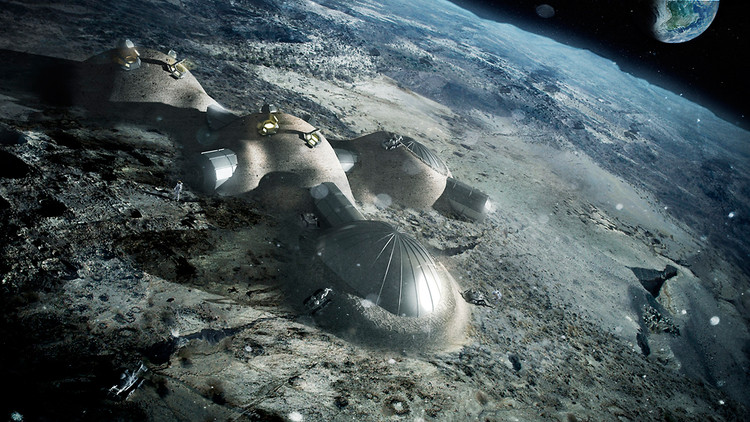
From molecular printing to volume manufacturing, roboticist Enrico Dini has fabricated a 3-D printer large enough to print houses from sand. He’s now teamed up with the European Space Agency to investigate deploying his D-Shape printer to the moon in hopes of churning lunar soil into a habitable base. Though realization of this effort remains distant, it’s notable to show how the thinking--and money--is moving to scale 3-D printing well beyond the desktop.
While printers integrate new materials and scale up to make bigger things, another approach to construction focuses on programming group dynamics. Like corals, beehives, and termite colonies, there’s a scalar effect gained from coordinating large numbers of simple agents towards complex goals.
The Robobees project at Harvard is exploring micro-scale robotics, wireless sensor arrays, and multi-agent systems to build robotic insects that exhibit the swarming behaviors of bees. They see a future where “coordinated agile robotic insects” are used for agriculture, search and rescue, and (of course) military surveillance. Taking a cue from mound-building termites, the TERMES project is developing a robotic swarm construction system. The team is working to get cooperative robots building things bigger than themselves by mapping the rules underlying emergence in autonomous distributed populations. Mike Rubenstein leads another Harvard lab, Kilobot, creating a “low cost scalable robot system for demonstrating collective behaviors.” His lab, along with the work of researcher’s like Nancy Lynch at MIT, are laying the frameworks for asynchronous distributed networks and multi-agent coordination, aka swarm robotics.
All of these projects are brewing in university and corporate labs but it’s likely that there are far more of them sprouting in garage shops and skunkworks across the globe. They each recapitulate the efficiency and conservation of natural systems through the convergence of biology and computation. Looking at the threads of algorithmic chemistry, bacterial manufacturing, and swarm robotics, and refracting them through our resource constraints, environmental degradation, and human security, we can develop some intriguing scenarios for the future.
“Within a decade or so, the barriers between biology and technology will start to fall."
Assuming a fairly linear scenario, the next decade should show steady progress in molecular modeling, yielding more breakthroughs in designer bacteria, nanosystems, and the hybridization of organic and inorganic materials. The software stack for algorithmic chemistry and synthetic biology will start to formalize, enabling better collaboration around libraries of biosynthetic design patterns. Additive printers will evolve to meet the demands of manufacturing at both volume and scale. Deployment of 3-D printers into the field for maintenance, disaster relief, and remote engineering projects will further drive their development.
Within a decade or so, the barriers between biology and technology will start to fall. At the atomic scale, nanosystems will bridge organic and inorganic structures while biologists engineer rudimentary cellular computers and bacterial printers. At the macro scale, robotic swarms will become more sophisticated, with the steady integration of bio-physiology into their mechanics, lifted by lightweight sensors and the rules underlying autonomy and multi-agent coordination.
“Architecture will lose its formal rigidity, softening and flexing and getting closer to the life we see in plants."
Future architects will work in modeling systems that stream biotemplates into their designs, solving for resource dependencies by ecosystem mapping in simulated environments. Their designs will exploit responsive meta-materials to confer sensing and adaptation to biomimetic curtain walls and building envelopes that flex and fold, opening and closing pores based on environmental conditions and population movements. Fleets of swarm constructors will assemble special scaffolding that guide bacteria specialized to grow the bones of the building, the vasculature, and the skin through which secondary swarms will plumb utilities. Printers will churn out conditioning systems and appliances and furnishings in adaptive materials. Architecture will lose its formal rigidity, softening and flexing and getting closer to the life we see in plants.
These vignettes are merely suggestive of how things may unfold from current trends. But the steady convergence of biology and computation will inevitably guide our hands to more closely align with natural systems. Precision design of programmable matter and a robust environment for simulation and rapid prototyping will reveal entirely new kinds of materials to build the world of tomorrow.
http://www.fastcoexist.com/1681891/cities-of-the-future-built-by-drones-bacteria-and-3-d-printers
Subscribe to:
Comments (Atom)