Showing posts with label Future. Show all posts

Tuesday, May 7, 2013

What’s Trending in Sports Turf Irrigation: Q&A with Jeff Bruce


Issue Date: May ST 2013, Posted On: 4/29/2013
 If you believe irrigation consultants just know sprinkler systems, you’re way off the mark. The American Society of Irrigation Consultants (ASIC) has spent the past 40-plus years training and supporting irrigation professionals in the industry in emerging water codes and regulations, water resource development and quality, turf management, soil science, chemistry, agronomy, horticulture, business development, marketing—you get the idea.

We caught up with Jeff Bruce, ASIC immediate past president, and principal of Jeffrey L. Bruce & Company (JLB) in North Kansas City, MO. Bruce founded JLB in 1986, and has rocketed to the top of the sports turf industry since, completing about 600 professional and NCAA sports complexes in the past 10 years alone, including Alex Box Baseball Stadium at LSU, Carolina Panthers Stadium, University of Kentucky Commonwealth Stadium, and Notre Dame Athletic Complex. We asked Bruce what’s trending in sports turf irrigation. His vision of the future might surprise you—it did us.
ASIC: Tell me about the role of an irrigation consultant in overall design and management of sports fields. How has that evolved over the past decade?

JLB: Our perspective is probably a little different because we don’t just consider the playing field; we profile the entire sports complex as an integrated system. These enterprises should be completely interconnected from the bottom up; drainage, catchment, soil profile, irrigation, turf type, and so forth. Then we consider usage, safety, longevity, resilience, budget, and maintenance and management needs and capabilities. Then we look at the surrounding grounds, the plant material, the water sources, the practice facilities, the parking facilities. It’s all interrelated.
Remember that for every stadium venue there are several practice fields that are used much more intensively. Typically there are more business opportunities for those than the stadiums so we like to tie them all together.

This has evolved into a business model for us that requires a lot of specialty expertise. I’m not sure anyone else does it, but clients like managing an entire project through a single consultant.
Is it a good representation of an irrigation consultant’s role? Maybe down the road. As we see more slippage of the market—more design-build and other solutions that don’t involve just irrigation—the irrigation consultant’s role might have to expand significantly into more than effectively developing and managing water resources.

ASIC:  Any new design or business trends in athletic fields that appear to be emerging?
JLB: A couple of things. We’ve seen a shift from high-performance turf and irrigation systems to more modest projects, mostly due to restrictive budgets in this slower economy. With the popularity of artificial turf, our primary business has fallen off a bit.

Artificial turf became pretty popular in the professional ranks, and now is becoming more popular at the high school and park & rec level. More recently, however, we’re seeing an inkling of a movement back to real grass. I think it’s related to the current generation of artificial turf products. There’s really not much history or background on the performance of these newer products, and decision-makers really have to evaluate claims by manufacturers with no ability to validate them.
We’re seeing quite a few second surface replacements in fields, about every 8-10 years. Because the artificial turf safety issue is still up for debate, and certain artificial fields promote higher injury incidents, there’s a prevailing feeling that artificial turf is okay, but grass is re-emerging as the preferred surface.

There’s also been a movement to large pay-for-play facilities, like big joint county-city projects of 15-20 soccer fields where fees are charged for use. We’re starting to see the higher end of those facilities coming back to turf, as well.
So those are trends we’re experiencing. What’s to come? I absolutely believe there will be intensive new regulations in water sourcing very soon. I further expect this trend to be a great opportunity for the irrigation and sports turf industries to be a huge part of an integrated green infrastructure paradigm.

When we look toward the development of unknown irrigation technology, we see stadiums and facilities using their fields as water harvesting and water polishing enterprises, so stadium and grounds rainwater, storm water and wastewater will be collected below the sports fields, then polished in a system and reused in the facility. We’ve been looking at this for awhile.
The challenge sports turf managers have is that they’re in control of very little. Few get to decide the field or facilities they have to work with. They have to become empowered to be in position to make a difference. They certainly have the knowledge and aspirations.

These things are coming, and sports turf managers should position themselves for more control over their professional destiny.


ASIC: What about water sources? How has that evolved over the last decade? Should we be moving away from using potable water for irrigation?

JLB: Clearly, water is being subsidized; its cost still is nowhere near the cost of supplying it. There’s only one way to generate enough water for the population. Higher water rates are coming, and we’ll see dramatic increases in cost.
There remains a myopic assumption in the industry that turf managers always will have the water they’ll need. But increasingly we’re seeing big park & rec facilities that are spending a lot of money on water starting to explore developing and using alternative sources.

The high-end collegiate and professional venues don’t really think much about the cost of water; they use potable water almost exclusively. It’s cheap. But they’re starting to have storm water regulation issues, so we’re designing drainage in the fields as storage and detention basins to meet storm water requirements. There’s not a big leap of faith to move from storm water detention to harvesting water for reuse.
In the future, a prominent part of any irrigation system is going to be subsurface cisterns to secure water for irrigation, and filtration systems to render that water usable. We’ll be off the municipal water and sewer systems; off the grid entirely. I think the Green Industry is starting to understand that, as green codes continue to trend toward net-zero water. Unless the industry gets ahead of this, we’ll be walking the plank and the plank will be cutoff. We need to get off the public systems and intercept water before it gets offsite.

ASIC: What irrigation system devices most determine performance and durability in sports venues?
JLB: Sports facilities definitely offer a different perspective. We have to ensure the safety of the athletes using the facility. That absolutely affects our irrigation equipment choices.

One of the sports turf industry’s biggest challenges is that irrigation systems are falling apart because to keep costs down at the design-installation phases, piping is being undersized resulting in over-pressurized systems. We get it—irrigation is judged by upfront costs; not longer-term costs. But by small-sizing the piping, a system’s life expectancy can be cut by as much as half, and certainly opportunities for efficient water use go down.
These systems lose a lot water and turf when they fail, plus too much pressure simply deteriorates efficiency. So we’re balancing two things: throwing water a long way to keep irrigation equipment off the field, which requires higher pressures; but keeping operating pressures as low as possible to minimize physical wear on equipment. We specify larger pipe and head sizes so velocities are reduced, and wear and tear are minimized. That’s one key to extending the irrigation system’s life. It absolutely requires some salesmanship.

Another component for consideration, particularly in sports fields, is controller systems. They’re almost too sophisticated. Oftentimes the features the average controller provides are way overdone.
We like to keep it simple. Today’s groundskeepers need more diagnostic tools than features. For example, moisture content is incredibly valuable information. There’s an opportunity for turf managers to employ more moisture sensing technology in their management toolbox. Fixed or portable, they provide a quantitative measure of soil moisture content for more effective water management.

ASIC: What are your best design components, from irrigation control systems to sprinkler heads to piping and quick-couplers to pressure regulation to soil prep?
JLB: We find a full range of equipment in manufacturers’ catalogues to solve most any specific problem. If you have high pressure, then pressure regulation is important at every stage, from mains to laterals. Using pressure gauges helps you identify spikes and better understand your system.

Isolation valves reign king. Although considered a luxury by some, the ability to isolate sections of a loop system in the event of a breach saves time, turf and equipment. Strategically placed isolation valves can be a manager’s best friend in a crisis. It’s important.
And then there are the smaller details, like accessing quick couplers for spot watering or syringing; or using quality swing joints instead of funny pipe. Not every solution is a big, impressive piece of equipment. High-performance systems should include all arrows in your quill to maintain a performance-tuned operation. Certainly stainless steel risers are important on sand-based facilities.

Use the irrigation manufacturers’ catalogue for distinct benefits that address system or site idiosyncrasies. There truly is a piece of equipment for every potential problem.
When you look at big sports complexes, the upfront cost of irrigation equipment is really pretty small compared to the cost of maintaining the fields themselves. It seems short-sighted to save $100 on a cheaper controller, but pay someone $25 an hour to adjust the runtimes. You might save that hundred bucks up front, but shell out $30,000 over a 20-year period. We need to be more sophisticated in our cost evaluations.

ASIC: Do you work off a template you’ve developed over the years or is every ball field project so unique that you start from scratch?
JLB: For years we would design irrigation for a stadium thinking it looked like the previous stadium. So we’d pull out our old project plans and specifications, and tweak them.  We realized at some point that each facility just became its own project. There’s ample uniqueness to sports fields and facilities that we have to start from scratch with each one. And it’s not just the quirkiness of the sites; turf managers also are unique in their management needs and preferences.

Most fields are used a number of different ways, so the parameters change with each project. There are different needs for lacrosse, than football, than soccer, than rugby, than concerts, than car shows. Different uses are going to affect the overall design.
Luke Frank is a freelance writer who submitted this article on behalf of the American Society of Irrigation Consultants, www.asic.org. Source: www.sportsturfonline.com/ME2/Audiences

Saturday, May 4, 2013

Cities of the Future: Built By Drones and Bacteria


By Chris Arkenberg
As scientists make huge strides in robotics, natural building materials, and new construction methods, our urban architecture could take on a much different form than the rigid construction we’re used to. As complex ecosystems, cities are confronting tremendous pressures to seek optimum efficiency with minimal impact in a resource-constrained world. While architecture, urban planning, and sustainability attempt to address the massive resource requirements and outflow of cities, there are signs that a deeper current of biology is working its way into the urban framework.
Innovations emerging across the disciplines of additive manufacturing, synthetic biology, swarm robotics, and architecture suggest a future scenario when buildings may be designed using libraries of biological templates and constructed with biosynthetic materials able to sense and adapt to their conditions. Construction itself may be handled by bacterial printers and swarms of mechanical assemblers.

“Buildings may be designed using libraries of biological templates and constructed with biosynthetic materials.”

 Much of the modern built environment we experience began its life in CAD software. In the Bio/Nano/Programmable Matter lab at Autodesk Research, engineers are developing tools to model the microscopic world. Project Cyborg helps researchers simulate atomic and molecular interactions, providing a platform to programmatically design matter. Autodesk recently partnered with Organovo, a firm developing functional bioprinters that can print living tissues. This pairing extends the possibilities from molecular design to biofabrication, enabling rapid prototyping of everything from pharmaceuticals to nanomachines.
Tools like Project Cyborg make possible a deeper exploration of biomimicry through the precise manipulation of matter. David Benjamin and his Columbia Living Architecture Lab explore ways to integrate biology into architecture. Their recent work investigates bacterial manufacturing--the genetic modification of bacteria to create durable materials. Envisioning a future where bacterial colonies are designed to print novel materials at scale, they see buildings wrapped in seamless, responsive, bio-electronic envelopes.
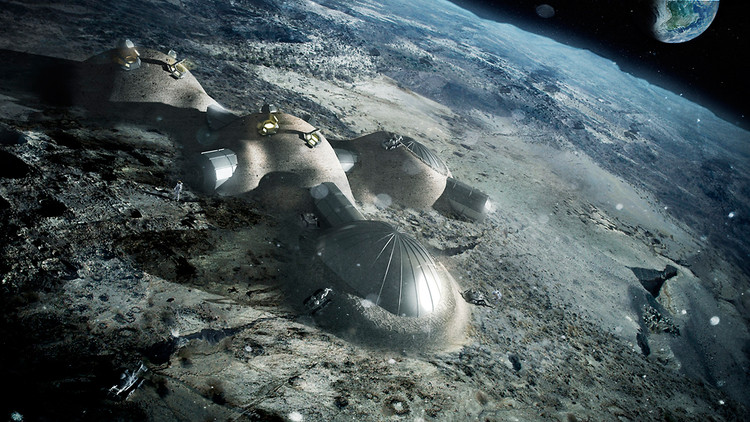
From molecular printing to volume manufacturing, roboticist Enrico Dini has fabricated a 3-D printer large enough to print houses from sand. He’s now teamed up with the European Space Agency to investigate deploying his D-Shape printer to the moon in hopes of churning lunar soil into a habitable base. Though realization of this effort remains distant, it’s notable to show how the thinking--and money--is moving to scale 3-D printing well beyond the desktop.
 

While printers integrate new materials and scale up to make bigger things, another approach to construction focuses on programming group dynamics. Like corals, beehives, and termite colonies, there’s a scalar effect gained from coordinating large numbers of simple agents towards complex goals.
The Robobees project at Harvard is exploring micro-scale robotics, wireless sensor arrays, and multi-agent systems to build robotic insects that exhibit the swarming behaviors of bees. They see a future where “coordinated agile robotic insects” are used for agriculture, search and rescue, and (of course) military surveillance. Taking a cue from mound-building termites, the TERMES project is developing a robotic swarm construction system. The team is working to get cooperative robots building things bigger than themselves by mapping the rules underlying emergence in autonomous distributed populations. Mike Rubenstein leads another Harvard lab, Kilobot, creating a “low cost scalable robot system for demonstrating collective behaviors.” His lab, along with the work of researcher’s like Nancy Lynch at MIT, are laying the frameworks for asynchronous distributed networks and multi-agent coordination, aka swarm robotics.
All of these projects are brewing in university and corporate labs but it’s likely that there are far more of them sprouting in garage shops and skunkworks across the globe. They each recapitulate the efficiency and conservation of natural systems through the convergence of biology and computation. Looking at the threads of algorithmic chemistry, bacterial manufacturing, and swarm robotics, and refracting them through our resource constraints, environmental degradation, and human security, we can develop some intriguing scenarios for the future.

“Within a decade or so, the barriers between biology and technology will start to fall."

 Assuming a fairly linear scenario, the next decade should show steady progress in molecular modeling, yielding more breakthroughs in designer bacteria, nanosystems, and the hybridization of organic and inorganic materials. The software stack for algorithmic chemistry and synthetic biology will start to formalize, enabling better collaboration around libraries of biosynthetic design patterns. Additive printers will evolve to meet the demands of manufacturing at both volume and scale. Deployment of 3-D printers into the field for maintenance, disaster relief, and remote engineering projects will further drive their development.
Within a decade or so, the barriers between biology and technology will start to fall. At the atomic scale, nanosystems will bridge organic and inorganic structures while biologists engineer rudimentary cellular computers and bacterial printers. At the macro scale, robotic swarms will become more sophisticated, with the steady integration of bio-physiology into their mechanics, lifted by lightweight sensors and the rules underlying autonomy and multi-agent coordination.
Further out on the horizon, this scenario means a greater coupling of biosystems and computation to evolve the living city. Bacteria will be engineered to target specific materials, like aging concrete. Released into cities, they will replace the old stuff with new bacterial glue that’s structurally sound, networked, and computational. Other bacteria could perform similar maintenance by retrofitting aging utility conduits and faded solar skins. Protocell computers could also be released into ecosystems, sensing chemical properties and transmitting them on mesh networks to remote dashboards. Vats of bacteria will pump out fuels, protein resources, and water.

 “Architecture will lose its formal rigidity, softening and flexing and getting closer to the life we see in plants."

 Future architects will work in modeling systems that stream biotemplates into their designs, solving for resource dependencies by ecosystem mapping in simulated environments. Their designs will exploit responsive meta-materials to confer sensing and adaptation to biomimetic curtain walls and building envelopes that flex and fold, opening and closing pores based on environmental conditions and population movements. Fleets of swarm constructors will assemble special scaffolding that guide bacteria specialized to grow the bones of the building, the vasculature, and the skin through which secondary swarms will plumb utilities. Printers will churn out conditioning systems and appliances and furnishings in adaptive materials. Architecture will lose its formal rigidity, softening and flexing and getting closer to the life we see in plants.
These vignettes are merely suggestive of how things may unfold from current trends. But the steady convergence of biology and computation will inevitably guide our hands to more closely align with natural systems. Precision design of programmable matter and a robust environment for simulation and rapid prototyping will reveal entirely new kinds of materials to build the world of tomorrow.
http://www.fastcoexist.com/1681891/cities-of-the-future-built-by-drones-bacteria-and-3-d-printers

Friday, January 4, 2013

The Green Wave: Sink or Swim


“The goal of life is living in agreement with nature.”

Zeno (335 BC-264 BC)

Sustainability is on the minds of every industry as the green movement has reached a critical mass. In the short time frame of fifteen years, green architecture and sustainable technologies have evolved from a radical fringe of ardent supporters to a generally accepted public mandate that is revolutionizing the entire world economy. Below the surface is a monumental shift in corporate thinking which is refining this brave new green world. Every industry will be challenged to make the shift to a new paradigm in order to prosper or even survive. The landscape and nursery industry has always been in the center of the green movement, but is not generally perceived as a leader which consistently brings innovation to the table. There can be no denying the magnitude of the sustainability movement as it becomes increasing codified in our daily life. The time is fast approaching for the landscape and nursery industry to assess its future and decide to either sink or swim in the mounting green wave. The commitment to become leaders in the sustainability movement will require dedication and innovation from both individual businesses as well as trade organizations.

The first question that arises is “what does it mean to be green?” Unfortunately, there are no publicly established policies or guidelines which are definitive, but rather a series of sometimes vague and confusing principals. Being green is easiest described as a way of thinking, in that every action shall do no wrong or diminish the earth’s resources for future generations. The difficult part is that every industry will be required to define these sustainable principals for their specific industry. Be assured that this process will not be simple and the rules will constantly change, but every industry will struggle in defining its role in the new green economy.

The origins of this green tidal wave can be traced back to a single document. In 1992, the City of Hanover, Germany hired architect William McDonough to craft a series of environmental principals to guide architects and planners in the development of exhibits for the 2000 World Expo to be held in Hanover. This short list of environmental goals came to be known as the Hanover Principals. Although over the years these sustainable principals have been expanded, interpreted, defined and debated, they are still the fundamental foundation of the sustainability movement.

As other industries begin to define their role in sustainability, they contribute useful tools which can help the landscape and nursery industry to find its way. Places to look for current thinking and valuable information include the United States Green Building Council (USGBC) www.usgbc.org, which has established the Leadership in Energy and Environmental Design (LEED) green building rating system. The American Society of Landscape Architects (ASLA) www.asla.org has established a strategic partnership with a number of environmental organizations called the Sustainable Site Initiative www.sustainablesites.org to establish a green site rating system for individual sites. There are a number of organizations such as “Cradle to Cradle Certification” www.mbdc.com/certified.html, which helps customers purchase and specify products that are pursuing a broader definition of quality environmentally-intelligent design. Industry specific guides are emerging such as the Certified Forest Products Council (CFPC) www.certifiedwood.org which provides information about sustainable forestry, and includes a directory of sustainably harvested lumber.

Although these organizations provide some insight in how sustainability is interrupted by other associations, none of the documents will address in detail the needs for the landscape and nursery industry. This will come from within the industry as we begin to look critically at the opportunities for changing traditional practices and replacing them with more environmentally friendly business practices. The initial areas for consideration are easy to identify such as business practices that negatively impact air quality, water quality, biodiversity and consumption of natural resources. Let’s look at each of these four simple opportunities in more detail as they might relate to traditional industry practices, knowing that there are dozens of other subjects that should be considered in mainstreaming sustainability into every aspect of the landscape and nursery industry.

Air Quality

With the emissions from operating and refueling of landscape equipment, vehicles have a significant impact on air quality. Small gasoline-powered engines often produce much greater levels of pollution than that of a full sized car per hour of operation. The estimates can be as much as 1000 times more emissions are produced from small gasoline-powered engines. When these engines are mistuned, or run without air filters, measurements show as much as 50% of the fuel exhausted as unburned hydrocarbons. The EPA estimates that as much as 5% of urban air pollution can be linked to their usage. Considering the entire carbon footprint of the landscape and nursery industry, the consequences are significant.

A sustainable approach would minimize air pollution by investing in hybrid or fossil free vehicle fleets as well as a mileage optimization on how those fleets are deployed each day. Small gas-powered engines can be replaced with electric powered equipment. While electric still has environmental impacts primarily in the manufacturing process, the total embodied energy used during the equipment’s life cycle cost is much less. The most environmentally friendly grounds maintenance equipment is human powered which does not rely on a power source. I believe there could be an emerging niche in the market for a premium priced high sustainability ground maintenance service.

Water Quality

The landscape and nursery industry applies a vast amount of chemical based pesticides and fertilizers which, even with the best management practices, are subject to leaching into stream ways and water courses. While monumental progress has been made in training grounds staff in the proper calibration and application of the chemicals, it does illustrate the industry’s reliance on preventative chemical use instead of prescriptive treatment of diseases. An enlightened chemical approach which reduces generic broad based preventative treatments in favor of selective targeted solutions would shift the chemical industry’s investment toward development of new softer solutions. A serious discussion in the landscape industry needs to challenge the reliance on traditional chemical approaches and foster greater acceptance of ecological based approaches.

The greatest impact the landscape and nursery industry has on water quality is in the management of construction activities through the primary responsibility for erosion control. Our experience indicates the landscape industry is only marginally engaged in erosion control. No other trade has a greater opportunity to express leadership in managing water quality during site grading and establishment of vegetation. This industry should be the foremost advocate and expert in site erosion control implementation. Accepting responsibility for the site can expand revenues for forward thinking companies.

With the increased development of suburban areas, more frequent and pronounced flooding has occured. This not only results in erosion, stream pollution, and destruction of aquatic habitat, but tremendous property damage and loss of human lives. Several compelling best management practices exist that the industry can use to help to reduce flooding and reuse a precious natural resource. These stormwater based solutions such as rain harvesting, rain gardens, green roofs and bioswales, while not new have garnered a new wave of public interest. The best thing about these stormwater technologies is that they easily fall into the traditional market of the industry. A concerted effort in promoting integrated stormwater solutions within the industry would represent another leadership position the industry could assume.

Declining Biodiversity

The world's biodiversity is declining at an unprecedented rate, with current extinction rates that are at least 900 times higher than natural rates found in the fossil record. Over 15,000 plant and animal species are now considered at risk of extinction representing an increase of 3,330 species since 2003. The landscape and nursery industry may contribute more to declining biodiversity than it does in preventing it. Consider the impacts of introduction of invasive plants into the landscape, clearing land, establishment of lawns, planting too few species that benefit wildlife, overuse of pesticides and dominant use of limited varieties of plants like Bradford pears and junipers.

When non-native plants "escape" from our landscape and take over natural areas they choke out the wide variety of native plants on which wildlife depends. Our desire for large lawn lots results in significant clearance of natural areas which fragments wildlife habitat. While less than 10% of all insects are harmful to plants, most pesticides are harmful or lethal to all insects. The industry maintains a dominant focus on horticultural planting strategies instead of advocating more complex ecological based plantings. We have become our own worst enemy in perpetuating traditional solutions as the basis of most designs.

A dramatic shift in conventional thinking is necessary to address sustainability in the core of the landscape and nursery industry. The industry needs to develop viable solutions to lawns and corporate landscapes in favor of diverse ecological natural communities which value biodiversity. We need to shift the basis of the green economy from low skilled lawn maintenance labor to more technically knowledgeable resource managers. Along with this paradigm shift comes increased market value and revenue opportunities. The need for biodiversity can be a catalyst in reforming traditional practices into a sustainable future.

Consumption of Natural Resources

The world only has a limited supply of natural resources and consumption rates are increasing. The United States is the world's largest consumer in absolute terms for many resources, eleven of the top twenty. Opportunities for using less are limitless when we look at our consumer economy. Principles for reducing consumption of natural resources can be applied to every aspect of business when you look at areas like packaging, recycling, specifying locally produced goods and use of low environmental impact materials.

Looking specifically at the landscape and nursery industry, specific opportunities emerge when we focus on business operations such as reducing fuel for landscape equipment, conserving water when irrigating plants, mitigating soil lost through erosion and eliminating peat moss or other harvested organic materials to amend soils. The green industry is indirectly responsible for 30% of water consumption in urban areas in the eastern United States for watering lawns, and in the West this figure is 60%. Guidelines for reduction or elimination of irrigation water are commonly available, but the environmental ethics need to be embraced by the entire industry. The green industry can be a powerful advocate in promoting sustainable solutions.

The world is shifting towards an environmental paradigm which fundamentally changes how we conduct every aspect of our lives. This green wave of change is upon us and it is our decision to sink or swim. We can allow the wave to overwhelm the industry or we can choose to participate as leaders riding the wave to a prosperous future of limitless opportunities. The future will be best defined for our industry internally by creative, innovative professions who have a passion for environmental change and civic commitment. By embracing the challenges to redefine our businesses practices at the most basis levels the industry will be guaranteed a meaningful front row seat in the new green economy. There is a lot of work to be done and a short amount of time available, so let’s get started in building a new green foundation for the future.

“Do not go where the path may lead, go instead where there is no path and leave a trail.”

Ralph Waldo Emerson