Showing posts with label Parks. Show all posts

Thursday, November 1, 2018

Nord Family Greenway Takes Shape in Cleveland


JBC is pleased to have been a part of the Sasaki team for this project. (from Cleveland Magazine)
The University Circle Inc. president tells us how the space connects the Hough neighborhood and University Circle.
Colorful colonials, white picket fences and wraparound porches line the Hough neighborhood’s Newton Avenue. The quaint road between East 101st Street and East 97th Street is one of Chris Ronayne’s favorites, but something about streets like Newton, Logan Court, Woodward Avenue and Lamont Avenue bothers him.
“It’s a very curious thing that our street infrastructure in an urban grid is chock-full of cul-de-sacs in the Hough neighborhood,” says the president of University Circle Inc. “Something was designed by intent, which seemed to create an insular mobility pattern. It doesn’t square with me.”
To Hough residents, those dead-end streets — along with a steep, unruly landscape and a wall of back-of-the-house architecture along Martin Luther King Jr. Drive on Case Western Reserve University’s southern campus — was a message: “Keep out.” But a few dozen steps away, Ronayne sees the Nord Family Greenway as “a physical statement about our intentionality to connect.”
Completed in June, the 15-acre green space links CWRU’s Tinkham Veale University Center and the reformed 1920s-era temple that now houses the Maltz Performing Arts Center. Running through the Cleveland Museum of Art’s Fine Arts Garden, the 2,200-foot-long stretch of grass, trees, tiered walkways and picnic areas expands a traditionally north-south campus to the east and west. Designed by Sasaki, the $15 million landscape project is the result of collaboration between the university, the art museum, the Cleveland Foundation and principal donors Eric and Jane Nord. 
But beyond a campus pathway and event space, the Greenway, which replaces that inward-facing design, is an overdue welcoming of the Hough neighborhood into University Circle’s cultural mecca. 
“Right now places feel a world away that are only five blocks away,” says Ronayne. “It’s on all of us if a kid within a mile of the Circle has never experienced a Circle institution.”
Yet, truly embracing Hough means matching brick-and-mortar efforts with social infrastructure. As examples, Ronayne mentions UCI’s Circle Scholars, an after-school program where seventh- and eighth-graders visit the museums and learn about local history from curators, or Future Connections, an eight-week course that teaches career skills to local high school seniors.
“We’ve got open jobs in the field of nursing and too few applicants,” he says. “We’d be remiss if we’re not locally teaching kids about the job opportunities of tomorrow.”
Strolling past the Chinese Cultural Garden, which may soon welcome more ethnic monuments as neighbors, the former Cleveland planning director points back to the space between East 105th Street and those dead-end Hough streets. 
Ronayne hopes the Greenway eventually reaches past Maltz to those streets. He also hopes to see the health care industry create hubs of economic innovation — things like the forthcoming Cleveland Clinic and CWRU dental clinic — in spaces like Mount Sinai.
“Now the next step is, ‘OK, I can get there, but now give me a reason to go,’ ” Ronayne says. “Obviously culture is a reason, but how about a job?”


Tuesday, January 12, 2016

Hypoallergenic Parks: Coming soon?


Hypoallergenic parks: Coming soon?
Garcia Lorca Park, one of the urban green spaces studied by CariƱanos Gonzalez and her team. Credit: Manuel Casares-Porcel.
Ah-choo! If you suffer from seasonal allergies, you're probably sick of this refrain. And you're not alone. Millions of Americans suffer from seasonal allergies. Moreover, there are allergy sufferers around the world echoing this allergy anthem.

Carinanos' interest in studying allergies started early. She and her seven brothers and sisters all suffer from seasonal allergies, a trait they inherited from their father. "Since I was young, I became an expert in everything associated with this disease, its symptoms, how to prevent it, avoid it, or treat it." Carinanos said. Despite this early interest in plants and allergies, she originally planned to attend veterinary school. But she says, "I think that my destiny was written, and I was admitted to the Faculty of Biology of the University of Cordoba."

Now she is an expert in the conservation and management of plants and wildlife. With her team, she studies how the plants in urban green spaces affect the air quality of that area. Then they look at how the air quality affects human health. Her team specifically studies the city of Granada, Spain. This city's climate and layout is like that of many cities in the Mediterranean area, which has the highest occurrence of pollen allergies in the world. The researchers hope their efforts will lead to fantastic urban green spaces that don't cause allergic reactions for 30% of the city's population.
Hypoallergenic parks: Coming soon?
Cypresses in the historical neighborhood Albayzin, in Granada. You can see how symbolic (and common) these trees are to the region. Credit: Paloma CariƱanos Gonzalez.
To start, Carinanos and her team began by classifying the trees in Granada's ten largest green spaces. They grouped the trees into three categories. Then they recorded the type of pollination, the length of the pollination period, and the potential for causing allergies for each tree. The researchers used all of this information to calculate if the green space was negatively affecting air quality and causing allergies.To start, Carinanos and her team began by classifying the trees in Granada's ten largest green spaces. They grouped the trees into three categories. Then they recorded the type of pollination, the length of the pollination period, and the potential for causing allergies for each tree. The researchers used all of this information to calculate if the green space was negatively affecting air quality and causing allergies.

 What the researchers found was surprising. Many of the most common trees in Granada were among the trees causing unhealthy or hazardous air quality. Carinanos also found it surprising that the design of these green spaces thought about landscaping, climate, and fashion criteria, but didn't think about pollen problems.

From their findings, the researchers have made suggestions for planning future green spaces. Their recommendations are to make sure that all citizens can enjoy the great outdoors with clear eyes and dry noses. Carinanos says that in the future, urban green spaces "will become 'comfort islands' inside 'urban heat islands.'" She wants to make sure these comfort islands are "for all citizens without exception."

This research may be just what allergy sufferers have been waiting for, and it's good news for others, too. Carefully selecting trees for green spaces may help combat climate change. Increasing the variety of trees in green spaces can both decrease allergies and increase the urban vegetation's ability to clean pollutants out of the air.

Carinanos and her team stress that their research is a tool for planning and prevention. They hope that other cities will be able to use their methods to prevent high allergen levels. Doing so may help growing city populations live more comfortably and with fewer health issues. The researchers ultimately want to ensure that urban green spaces play a role in keeping both the climate and people healthy.

http://phys.org/news/2015-08-hypoallergenic.html

Monday, December 28, 2015

The Privatization of Cities' Public Spaces is Escalating. It is time to take a stand.


The Granary Square ‘Pops’ in London’s King’s Cross is one of the largest open-air spaces in Europe. Photograph: John Sturrock for the Guardian


I was recently sent a link to a YouTube video entitled We Too, in which a trespasser sneaks into the under-construction, 34-story Lexicon skyscraper near the Silicon Roundabout in London, and pitches a tent on the top floor.

In the video, after a good night’s sleep, the interloper unzips the front flap of the shelter and steps into the early-morning air. The city unfolds before him in a stunning vista, suggesting the view that future occupants of the skyscraper will enjoy – or, more likely in London, the view that international investors will use as a selling point when they put the flat back on the market after a few years of not living in it.

Later that day, I received another link to Craigslist where the Lexicon lurker, as I came to call him, had placed an ad for a “highly affordable luxury penthouse in Islington”, illustrated with a crisp photo of his tent overlooking the city. The punchline of this performance – that “we too sleep in penthouses” – was a playful way of re-framing the most pressing concern in the neoliberal city: who is it actually for?

The geographer David Harvey once wrote that “the freedom to make and remake our cities and ourselves is … one of the most precious yet most neglected of our human rights”. Generations of urban theorists, from Lewis Mumford to Jane Jacobs to Doreen Massey, have suggested that the place where cities get “remade” is in the public rather than private sphere. Part of the problem, then, with privately owned public spaces (“Pops”) – open-air squares, gardens and parks that look public but are not – is that the rights of the citizens using them are severely hemmed in. Although this issue might be academic while we’re eating our lunch on a private park bench, the consequences of multiplying and expanding Pops affects everything from our personal psyche to our ability to protest.

Let me offer two examples from other cities. I am originally from Los Angeles and recently went back to visit. When I asked an old friend where you could find the public space in LA, his response was: “What, to buy?” This sounds like sarcasm, but Los Angeles is a city infamous for slaying public space and public transportation. My friend clarified his genuine confusion later when he sent me a Los Angeles Times article about how the city had begun to sell slivers of pavement on the private market intended for crafty entrepreneurs looking for ad space.

So there’s one model – and here’s another. A few years back, I was in Phnom Penh, Cambodia, and I asked a colleague if we could go somewhere photogenic. I was taken to Vann Molyvann’s 1964 National Stadium, a Brutalist behemoth built in anticipation of the Southeast Asian Peninsular Games in 1963.
When we arrived, the place was filled with hundreds of people, none that I could see in any sort of official capacity. Some were conducting open-air aerobics classes, others were selling barbecued corn from rolling carts, a few people were air-drying laundry and many were just milling about on foot or scooters. I even met a child taking a bath in a bucket, who tried to douse me. Nothing was locked. I went in and out of areas at will, including the vast indoor stadium, which was unoccupied except for a few kids smoking a joint. There was an intense energy in the air that came from a little sprinkling of chaos – a feeling that anything could happen here.

‘The place was filled with people, none in any kind of official capacity’ ... Phnom Penh’s National Stadium offers a different model of public space. Photograph: Bradley L Garrett 
It was then I realized that one problem with Pops is they lack that kind of energy. They feel too monitored, too controlled, to allow this communal activity to simply unfold. London, and many other cities, are failing miserably to enable diversity in people’s engagement with such spaces.

In 2012, the Guardian ran a campaign to crowdsource data about Pops in Britain. The project, though incomplete, suggested a clear pattern. Having begun to be built in the 1980s (unsurprisingly), Pops around the country increased steadily in number through the 2000s, and also grew in size. This includes the estate of More London, a 13-acre expanse stretching down the Thames’s Southbank. It was completed in 2003 and sold off in 2013 to Kuwaiti property company St Martins for £1.7bn, in one of the largest commercial property deals in British history.

In the process, the transformation of the areas outside City Hall into a Pops means it is no longer possible to protest outside the headquarters of the mayor and the Greater London Authority (GLA). Or to take photos, apparently: when I was filming with Channel 4 there last year, we were swiftly removed from the property. This is nothing new. In 2010, during a London Assembly planning and housing committee meeting, Jenny Jones, from the Green party, said: “It has taken us eight years to negotiate with More London so that we politicians can do a TV interview outside our own building.”

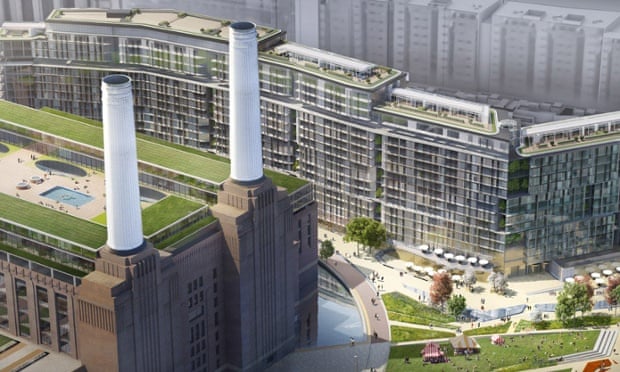
Despite multiple objections from politicians and notwithstanding Boris Johnson’s 2011 Manifesto for Public Space, the construction of Pops such as More London is continuing to escalate and expand, including nine acres planned in Tower Hamlets, a vast patch outside the Battersea Power Station development, and open space and parks at Woodberry Down near Manor House, where I was chased around for taking photos a few months ago. Given how all these developments seem to contradict stated city authority goals to increase public space that is actually publicly owned, one could be forgiven for thinking that the GLA is not actually in control of development in London.

The proposed redevelopment of Battersea Power Station, which will be a privately owned public space.
The proposed redevelopment of Battersea Power Station will include yet more privately owned public space. Photograph: LDA Design

So what is it we expect to happen in public space? In 2008, geographer Ash Amin wrote that “public spaces marked by the unfettered circulation of bodies [produce] new rhythms from the many relational possibilities”. I experienced elements of this in the Phnom Penh National Stadium. But, when space is controlled, and especially when the public is unclear about what the legal or acceptable boundaries of activity are, we tend to police ourselves, to monitor our behaviour and to limit our interactions, especially after embarrassing confrontations with security.

Property owners are perfectly aware of this and prey on those sensibilities. The new King’s Cross development at Granary Square is one of the largest open-air spaces in Europe – about the same size as Trafalgar Square. Unlike Trafalgar Square, it is also a Pops. Photographer Nicholas Goodden set up a tripod there recently to take a photo, and was immediately asked by security whether he had a permit to do so. When he said he did not, he was ordered to move across the canal to get his image. In other words, he was kicked out of “public” space. This would not have happened to a photojournalist in Trafalgar Square, which is owned by the Crown and managed by the Greater London Authority.

Moreover, an encounter with security like this may make you wary and cause you to confine your behaviour to a narrow range so as to avoid confrontation. The psychological effects of this sort of self-policing were written about by Michel Foucault: “He who is subjected to a field of visibility, and who knows it, assumes responsibility for the constraints of power; he makes them play spontaneously upon himself; he inscribes in himself the power relation in which he simultaneously plays both roles; he becomes the principle of his own subjection.”

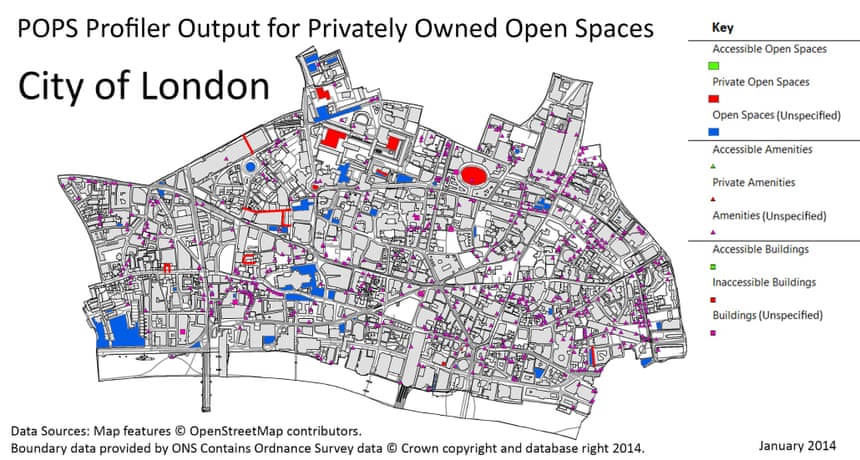
Oliver Dawkins's Pops Profiler.
The Pops Profiler, by Casa student Oliver Dawkins, shows privately owned public space in London’s Square Mile
Geographer Don Mitchell suggests that what public space provides in a city under surveillance are small islands of freedom surrounded by Foucault’s “carceral archipelago” – the surveilled city. Herein lies a crucial question: what happens when our small islands of freedom become indistinguishable from the rest of the city? Sociologist Richard Sennett suggests that private public spaces are “dead public spaces” because the essence of conviviality, spontaneity, encounter and yes, that little sprinkle of chaos, have been stripped out. The spaces are not rendered dead because they aren’t enjoyable – I myself enjoy lounging on the steps near the canal at Granary Square – but dead because the potential range of spatial engagement here can fit in a coffee cup.

“By claiming space in public, by creating public spaces, social groups themselves become public,” Mitchell writes. “Only in public spaces can the homeless, for example, represent themselves as a legitimate part of ‘the public’.” I’m sure we can all imagine how Granary Square security might respond to a homeless Londoner making their woes public on their private AstroTurf.

The power for corporate entities to not only impede certain activities but to bar the public access to “public” space was upheld during the Occupy protest court proceedings. On 14 October 2011, an injunction passed “preventing ‘persons unknown’ entering or remaining in or trespassing on [Paternoster Square]”. While Occupy may seem like ancient history, these proceedings were important because they set a precedent: protest would not be tolerated in open-air private space.

It is no coincidence that the aforementioned Lexicon lurker deployed a tent in his bogus ad. The tent has become a powerful totem: from Brian Haw to Occupy, it symbolizes the bringing of the domestic sphere into the public, and has become so feared by authorities that Westminster City Council passed bylaws in 2012 “to regulate tents and other structures and sleeping equipment”. So much for urban camping

At a recent TEDx Southampton University event about public space in London, I suggested that the moment for direct action against the loss of public space is upon us – an action that would echo the mass trespass of Kinder Scout by the Rambler’s Association in 1932, described by Lord Roy Hattersley as “the most successful direct action in British history”. Taking action by finding and using public space sidesteps the thorny, and frankly depressing, issue of what has been lost. Instead, it focuses on what we can do.

The first hurdle, however, is that public space in London has not been mapped in any sort of systematic way. Oliver Dawkins, doing degree work at UCL’s Centre for Advanced Spatial Analysis (Casa), created a “Pops Profiler” that enables us to see how this plays out in the Square Mile. Publicly available data on Open Street Maps (OSM) do not indicate a single open space that is explicitly designated as publicly accessible (though there are many where ownership is “unspecified”). This suggests that OSM users can’t tell which open spaces are public and which are private.

Last year, when I tried to walk a section of the Thames Path with Jack Shenker and Anna Minton, we found many underutilised parts of the trail – including one that a building security guard asked for identification to access. Hostile architecture intimidates people away from access, poor signage misdirects them. What I suggest in my TEDx talk is that we should start systematically mapping out and using these public spaces to raise awareness about what we have – before we lose it.

So that’s my plan. Along the way, in a series of articles for Guardian Cities, I intend to tackle overarching questions about where public spaces are, and what they are for. I am also interested in the ways that people subvert private space by undertaking “public” acts without permission, to create what Hakim Bey calls “temporary autonomous zones”. The deployment of the tent on Lexicon Tower is a good example of that.

As an ethnographer, I am keen to approach this project from the ground up, seeking out small acts and helping to organised events in public spaces. The fundamental question for me is one of visibility. If information about public space – where it is, what we can do in it – is not clear, then small acts can reveal what is and is not possible ... which we can then map. If you have a story you would like to share for inclusion in future pieces, please do get in touch.

http://www.theguardian.com/cities/2015/aug/04/pops-privately-owned-public-space-cities-direct-action

Thursday, September 25, 2014

What a Park’s Design Does to Your Brain


AP Photo/Julie Jacobson
 As a student in Poland, Agnieszka Anna Olszewska was fascinated by the way that some landscapes seemed to be more contemplative than others. She wanted to research the reasons behind that calming effect, but she found little encouragement. “People told me I can write a novel, I can write a poem about the contemplativeness of landscape, but not a scientific paper.” One well-respected landscape architect told her it couldn’t be done because of the diversity of human responses: Some of us might find a garden conducive to contemplation; others might prefer the bathroom.
But Olszewska, now a doctoral candidate in landscape architecture and urban ecology at the University of Porto in Portugal, persevered. With a neuroscience professor at the university, she conducted a pilot project that culminated, earlier this year, in a conference paper titled “Urban Planning, Neurosciences and Contemplation for Improving Well-being in Our Cities.” It combined questionnaire results with measurement of brain waves in an effort “to prove that there are certain characteristics of urban parks and gardens that can induce in the visitor the pattern of brain activity that is associated with contemplative or meditative states.”

We know that cities can be hectic, stressful places. We also know that green space can have a calming effect on people. But Olszewska is seeking to take our knowledge a step further — to enable designers and planners to maximize the serenity of urban green refuges.

In the study, four design experts examined 50 photographs from three urban parks in Portugal and France. The experts were also given a checklist of design features (such as long-distance views, biodiversity, “canopied,” “panoramic”). They identified which features appeared in each photograph, and also evaluated each setting’s contemplativeness. The settings deemed most contemplative had panoramic vistas with long-distance views (more than 400 meters). They tended to include large empty spaces, natural asymmetry, clearings and stimulation to look at the sky. The least contemplative settings, by contrast, usually lacked these features, and instead had characteristics such as paths and enclosed spaces (as in small pocket gardens).

In the second part of the project, subjects were asked to look at the 15 photos of landscapes ranked highest by the experts for contemplativeness. Their brain waves were recorded by electroencephalography (EEG) during this task. The brain activity, Olszewska said, was similar to patterns known to be associated with mindfulness achieved through meditation. She stresses, though, that her research is quite preliminary; subjects weren’t shown the least contemplative spaces. (She is currently working on a study that includes this kind of control group.)

The most contemplative landscapes are not necessarily the ones that people would claim to enjoy the most. More stimulating landscapes — brightly colored flowers, numerous eye-catching elements — may be more immediately attractive. “If you imagine the French baroque gardens, they are very geometrical, very organized,” said Olszewska. But this kind of environment, however beautiful, may be less relaxing to spend time in.

This is not to say that the opposite extreme — wild landscapes — are necessarily more contemplative. Olszewska thinks we tend to find those overwhelming. Instead, she hypothesizes that the ideal is a “golden middle” between too much design and too little.

The small experiment is part of a larger, nascent movement to try to connect neuroscience to architecture and design. The movement for “evidence-based design” originated in the health care field. One famous finding was that in hospitals — historically not the most pleasant places — surgical patients whose windows faced natural outdoor scenery were discharged sooner and requested fewer painkillers than patients whose windows faced a brick wall. Inspired by this movement, others began to think that there was no reason to limit such thinking to hospitals. It spread to schools, and now, increasingly, the built environment and urban green spaces. Some researchers began to incorporate neuroscience. Much of the interest is focused on contemplativeness. Perhaps, just as hospitals need healing spaces, cities need serene oases to counteract the urban chaos.

Julio Bermudez, an associate professor of architecture and planning at the Catholic University of America, studies how the built environment can induce states of relaxation and mindfulness. In one study, which he presented last week at the second annual conference of the Academy of Neuroscience for Architecture, architects looked at photographs of buildings designed to be contemplative, including the Salk Institute in San Diego and the Pantheon in Rome, as well as ordinary buildings. The contemplative buildings reportedly elicited “markedly distinct” responses, as measured by functional Magnetic Resonance Imaging (fMRI). Bermudez and his co-authors (including a neuroscientist at the University of Utah) concluded that contemplative buildings “allow subjects to enter into a meditative state with diminishing levels of anxiety and mind wandering.”

In an email, Bermudez speculated about some common features of contemplative design: buildings that frame nature in some way; that exhibit simplicity without being simplistic; and that offer a sense of separation from the rest of their context, among other qualities. Some “remarkable cities,” he wrote, “naturally invite contemplative states.” As examples, he cited Santiago de Compostela in Spain and Bodh Gaya in India, as well as parts of Paris, Washington D.C. and San Francisco.

It may be true that, as the landscape architect warned Olszewska, it’s hard to make blanket generalizations about what people find contemplative, and responses may vary culturally too. It’s also notoriously challenging to interpret brain waves conclusively, and this research is in its infancy. But both Olszewska and Bermudez believe there are certain common features that can broadly foster these meditative responses. And rather than write poems, they hope to prove it with the tools of fMRI and EEG.

The Science of Cities column is made possible with the support of the John D. and Catherine T. MacArthur Foundation.

Rebecca Tuhus-Dubrow is a columnist for Next City. She has also written for the New York Times, Slate and Dissent, among other publications.

 http://nextcity.org/daily/entry/city-parks-design-calming-brain

Sunday, February 3, 2013