Showing posts with label Robotics. Show all posts
Wednesday, February 19, 2014
Robotic Construction Crew Needs No Foreman
Inspired by the termites' resilience and collective intelligence, a team of computer scientists and engineers at the Harvard School of Engineering and Applied Sciences (SEAS) and the Wyss Institute for Biologically Inspired Engineering at Harvard University has created an autonomous robotic construction crew. The system needs no supervisor, no eye in the sky, and no communication: just simple robots -- any number of robots -- that cooperate by modifying their environment.
Harvard's TERMES system demonstrates that collective systems of robots can build complex, three-dimensional structures without the need for any central command or prescribed roles. The results of the four-year project were presented this week at the AAAS 2014 Annual Meeting and published in the February 14 issue of Science.
The TERMES robots can build towers, castles, and pyramids out of foam bricks, autonomously building themselves staircases to reach the higher levels and adding bricks wherever they are needed. In the future, similar robots could lay sandbags in advance of a flood, or perform simple construction tasks on Mars.
"The key inspiration we took from termites is the idea that you can do something really complicated as a group, without a supervisor, and secondly that you can do it without everybody discussing explicitly what's going on, but just by modifying the environment," says principal investigator Radhika Nagpal, Fred Kavli Professor of Computer Science at Harvard SEAS. She is also a core faculty member at the Wyss Institute, where she co-leads the Bioinspired Robotics platform.
Most human construction projects today are performed by trained workers in a hierarchical organization, explains lead author Justin Werfel, a staff scientist in bioinspired robotics at the Wyss Institute and a former SEAS postdoctoral fellow.
"Normally, at the beginning, you have a blueprint and a detailed plan of how to execute it, and the foreman goes out and directs his crew, supervising them as they do it," he says. "In insect colonies, it's not as if the queen is giving them all individual instructions. Each termite doesn't know what the others are doing or what the current overall state of the mound is."
Instead, termites rely on a concept known as stigmergy, a kind of implicit communication: they observe each others' changes to the environment and act accordingly. That is what Nagpal's team has designed the robots to do, with impressive results. Supplementary videos published with the Science paper show the robots cooperating to build several kinds of structures and even recovering from unexpected changes to the structures during construction.
Each robot executes its building process in parallel with others, but without knowing who else is working at the same time. If one robot breaks, or has to leave, it does not affect the others. This also means that the same instructions can be executed by five robots or five hundred. The TERMES system is an important proof of concept for scalable, distributed artificial intelligence.
Nagpal's Self-Organizing Systems Research Group specializes in distributed algorithms that allow very large groups of robots to act as a colony. Close connections between Harvard's computer scientists, electrical engineers, and biologists are key to her team's success. They created a swarm of friendly Kilobots a few years ago and are contributing artificial intelligence expertise to the ongoing RoboBees project, in collaboration with Harvard faculty members Robert J. Wood and Gu-Yeon Wei.
"When many agents get together -- whether they're termites, bees, or robots -- often some interesting, higher-level behavior emerges that you wouldn't predict from looking at the components by themselves," says Werfel. "Broadly speaking, we're interested in connecting what happens at the low level, with individual agent rules, to these emergent outcomes."
Coauthor Kirstin Petersen, a graduate student at Harvard SEAS with a fellowship from the Wyss Institute, spearheaded the design and construction of the TERMES robots and bricks. These robots can perform all the necessary tasks -- carrying blocks, climbing the structure, attaching the blocks, and so on -- with only four simple types of sensors and three actuators.
"We co-designed robots and bricks in an effort to make the system as minimalist and reliable as possible," Petersen says. "Not only does this help to make the system more robust; it also greatly simplifies the amount of computing required of the onboard processor. The idea is not just to reduce the number of small-scale errors, but more so to detect and correct them before they propagate into errors that can be fatal to the entire system."
In contrast to the TERMES system, it is currently more common for robotic systems to depend on a central controller. These systems typically rely on an "eye in the sky" that can see the whole process or on all of the robots being able to talk to each other frequently. These approaches can improve group efficiency and help the system recover from problems quickly, but as the numbers of robots and the size of their territory increase, these systems become harder to operate. In dangerous or remote environments, a central controller presents a single failure point that could bring down the whole system.
"It may be that in the end you want something in between the centralized and the decentralized system -- but we've proven the extreme end of the scale: that it could be just like the termites," says Nagpal. "And from the termites' point of view, it's working out great."
This research was supported by the Wyss Institute for Biologically Inspired Engineering at Harvard University.
What can a TERMES robot do?
- Move forward, backward, and turn in place
- Climb up or down a step the height of one brick
- Pick up a brick, carry it, and deposit it directly in front of itself
- Detect other bricks and robots in immediate vicinity
- Keep track of its own location with respect to a "seed" brick
What instructions do the TERMES robots follow?
- Obey predetermined traffic rules
- Circle the growing structure to find the first, "seed" brick (for orientation)
- Climb onto the structure
- Obtain a brick
- Attach the brick at any vacant point that satisfies local geometric requirements
- Climb off the structure
- Repeat
http://www.sciencedaily.com/releases/2014/02/140213142134.htm
Saturday, May 4, 2013
Cities of the Future: Built By Drones and Bacteria
By Chris Arkenberg
As scientists make huge strides in robotics, natural building materials, and new construction methods, our urban architecture could take on a much different form than the rigid construction we’re used to. As complex ecosystems, cities are confronting tremendous pressures to seek optimum efficiency with minimal impact in a resource-constrained world. While architecture, urban planning, and sustainability attempt to address the massive resource requirements and outflow of cities, there are signs that a deeper current of biology is working its way into the urban framework.
Innovations emerging across the disciplines of additive manufacturing, synthetic biology, swarm robotics, and architecture suggest a future scenario when buildings may be designed using libraries of biological templates and constructed with biosynthetic materials able to sense and adapt to their conditions. Construction itself may be handled by bacterial printers and swarms of mechanical assemblers.
“Buildings may be designed using libraries of biological templates and constructed with biosynthetic materials.”
Much of the modern built environment we experience began its life in CAD software. In the Bio/Nano/Programmable Matter lab at Autodesk Research, engineers are developing tools to model the microscopic world. Project Cyborg helps researchers simulate atomic and molecular interactions, providing a platform to programmatically design matter. Autodesk recently partnered with Organovo, a firm developing functional bioprinters that can print living tissues. This pairing extends the possibilities from molecular design to biofabrication, enabling rapid prototyping of everything from pharmaceuticals to nanomachines.
Tools like Project Cyborg make possible a deeper exploration of biomimicry through the precise manipulation of matter. David Benjamin and his Columbia Living Architecture Lab explore ways to integrate biology into architecture. Their recent work investigates bacterial manufacturing--the genetic modification of bacteria to create durable materials. Envisioning a future where bacterial colonies are designed to print novel materials at scale, they see buildings wrapped in seamless, responsive, bio-electronic envelopes.
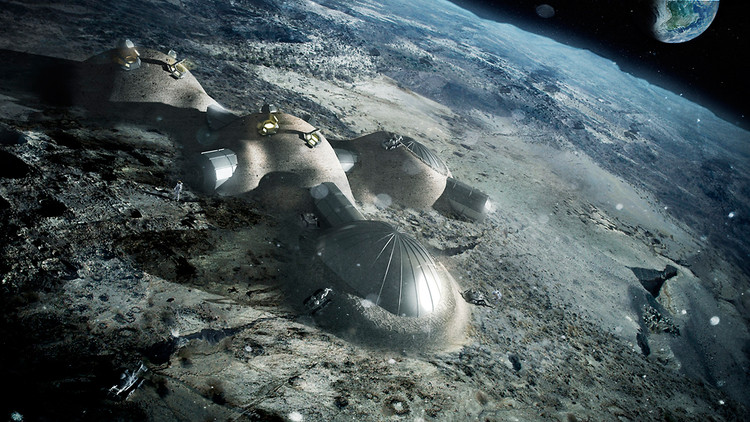
From molecular printing to volume manufacturing, roboticist Enrico Dini has fabricated a 3-D printer large enough to print houses from sand. He’s now teamed up with the European Space Agency to investigate deploying his D-Shape printer to the moon in hopes of churning lunar soil into a habitable base. Though realization of this effort remains distant, it’s notable to show how the thinking--and money--is moving to scale 3-D printing well beyond the desktop.
While printers integrate new materials and scale up to make bigger things, another approach to construction focuses on programming group dynamics. Like corals, beehives, and termite colonies, there’s a scalar effect gained from coordinating large numbers of simple agents towards complex goals.
The Robobees project at Harvard is exploring micro-scale robotics, wireless sensor arrays, and multi-agent systems to build robotic insects that exhibit the swarming behaviors of bees. They see a future where “coordinated agile robotic insects” are used for agriculture, search and rescue, and (of course) military surveillance. Taking a cue from mound-building termites, the TERMES project is developing a robotic swarm construction system. The team is working to get cooperative robots building things bigger than themselves by mapping the rules underlying emergence in autonomous distributed populations. Mike Rubenstein leads another Harvard lab, Kilobot, creating a “low cost scalable robot system for demonstrating collective behaviors.” His lab, along with the work of researcher’s like Nancy Lynch at MIT, are laying the frameworks for asynchronous distributed networks and multi-agent coordination, aka swarm robotics.
All of these projects are brewing in university and corporate labs but it’s likely that there are far more of them sprouting in garage shops and skunkworks across the globe. They each recapitulate the efficiency and conservation of natural systems through the convergence of biology and computation. Looking at the threads of algorithmic chemistry, bacterial manufacturing, and swarm robotics, and refracting them through our resource constraints, environmental degradation, and human security, we can develop some intriguing scenarios for the future.
“Within a decade or so, the barriers between biology and technology will start to fall."
Assuming a fairly linear scenario, the next decade should show steady progress in molecular modeling, yielding more breakthroughs in designer bacteria, nanosystems, and the hybridization of organic and inorganic materials. The software stack for algorithmic chemistry and synthetic biology will start to formalize, enabling better collaboration around libraries of biosynthetic design patterns. Additive printers will evolve to meet the demands of manufacturing at both volume and scale. Deployment of 3-D printers into the field for maintenance, disaster relief, and remote engineering projects will further drive their development.
Within a decade or so, the barriers between biology and technology will start to fall. At the atomic scale, nanosystems will bridge organic and inorganic structures while biologists engineer rudimentary cellular computers and bacterial printers. At the macro scale, robotic swarms will become more sophisticated, with the steady integration of bio-physiology into their mechanics, lifted by lightweight sensors and the rules underlying autonomy and multi-agent coordination.
“Architecture will lose its formal rigidity, softening and flexing and getting closer to the life we see in plants."
Future architects will work in modeling systems that stream biotemplates into their designs, solving for resource dependencies by ecosystem mapping in simulated environments. Their designs will exploit responsive meta-materials to confer sensing and adaptation to biomimetic curtain walls and building envelopes that flex and fold, opening and closing pores based on environmental conditions and population movements. Fleets of swarm constructors will assemble special scaffolding that guide bacteria specialized to grow the bones of the building, the vasculature, and the skin through which secondary swarms will plumb utilities. Printers will churn out conditioning systems and appliances and furnishings in adaptive materials. Architecture will lose its formal rigidity, softening and flexing and getting closer to the life we see in plants.
These vignettes are merely suggestive of how things may unfold from current trends. But the steady convergence of biology and computation will inevitably guide our hands to more closely align with natural systems. Precision design of programmable matter and a robust environment for simulation and rapid prototyping will reveal entirely new kinds of materials to build the world of tomorrow.
http://www.fastcoexist.com/1681891/cities-of-the-future-built-by-drones-bacteria-and-3-d-printers
Subscribe to:
Posts (Atom)