Garcia Lorca Park, one of the urban green spaces studied by Cariñanos Gonzalez and her team. Credit: Manuel Casares-Porcel.
Ah-choo! If you suffer from seasonal allergies, you're probably sick of this refrain. And you're not alone. Millions of Americans suffer from seasonal allergies. Moreover, there are allergy sufferers around the world echoing this allergy anthem.
Among the ranks is Paloma Carinanos, a professor of Botany at the University of Granada, in Spain. Rather than sitting back with a box of tissue, Dr. Carinanos has taken a more proactive approach to fighting her seasonal allergies. She studies how the trees in urban green spaces contribute to and even cause allergies.
Carinanos' interest in studying allergies started early. She and her seven brothers and sisters all suffer from seasonal allergies, a trait they inherited from their father. "Since I was young, I became an expert in everything associated with this disease, its symptoms, how to prevent it, avoid it, or treat it." Carinanos said. Despite this early interest in plants and allergies, she originally planned to attend veterinary school. But she says, "I think that my destiny was written, and I was admitted to the Faculty of Biology of the University of Cordoba."
Now she is an expert in the conservation and management of plants and wildlife. With her team, she studies how the plants in urban green spaces affect the air quality of that area. Then they look at how the air quality affects human health. Her team specifically studies the city of Granada, Spain. This city's climate and layout is like that of many cities in the Mediterranean area, which has the highest occurrence of pollen allergies in the world. The researchers hope their efforts will lead to fantastic urban green spaces that don't cause allergic reactions for 30% of the city's population.
Cypresses in the historical neighborhood Albayzin, in Granada. You can see how symbolic (and common) these trees are to the region. Credit: Paloma Cariñanos Gonzalez.
To start, Carinanos and her team began by classifying the trees in Granada's ten largest green spaces. They grouped the trees into three categories. Then they recorded the type of pollination, the length of the pollination period, and the potential for causing allergies for each tree. The researchers used all of this information to calculate if the green space was negatively affecting air quality and causing allergies.To start, Carinanos and her team began by classifying the trees in Granada's ten largest green spaces. They grouped the trees into three categories. Then they recorded the type of pollination, the length of the pollination period, and the potential for causing allergies for each tree. The researchers used all of this information to calculate if the green space was negatively affecting air quality and causing allergies.
What the researchers found was surprising. Many of the most common trees in Granada were among the trees causing unhealthy or hazardous air quality. Carinanos also found it surprising that the design of these green spaces thought about landscaping, climate, and fashion criteria, but didn't think about pollen problems.
From their findings, the researchers have made suggestions for planning future green spaces. Their recommendations are to make sure that all citizens can enjoy the great outdoors with clear eyes and dry noses. Carinanos says that in the future, urban green spaces "will become 'comfort islands' inside 'urban heat islands.'" She wants to make sure these comfort islands are "for all citizens without exception."
This research may be just what allergy sufferers have been waiting for, and it's good news for others, too. Carefully selecting trees for green spaces may help combat climate change. Increasing the variety of trees in green spaces can both decrease allergies and increase the urban vegetation's ability to clean pollutants out of the air.
Carinanos and her team stress that their research is a tool for planning and prevention. They hope that other cities will be able to use their methods to prevent high allergen levels. Doing so may help growing city populations live more comfortably and with fewer health issues. The researchers ultimately want to ensure that urban green spaces play a role in keeping both the climate and people healthy.
I was recently sent a link to a YouTube video entitled We Too, in which a trespasser sneaks into the under-construction, 34-story Lexicon skyscraper near the Silicon Roundabout in London, and pitches a tent on the top floor.
In the video, after a good night’s sleep, the interloper unzips the front flap of the shelter and steps into the early-morning air. The city unfolds before him in a stunning vista, suggesting the view that future occupants of the skyscraper will enjoy – or, more likely in London, the view that international investors will use as a selling point when they put the flat back on the market after a few years of not living in it.
Later that day, I received another link to Craigslist where the Lexicon lurker, as I came to call him, had placed an ad for a “highly affordable luxury penthouse in Islington”, illustrated with a crisp photo of his tent overlooking the city. The punchline of this performance – that “we too sleep in penthouses” – was a playful way of re-framing the most pressing concern in the neoliberal city: who is it actually for?
The geographer David Harvey once wrote that “the freedom to make and remake our cities and ourselves is … one of the most precious yet most neglected of our human rights”.Generations of urban theorists, from Lewis Mumford to Jane Jacobs to Doreen Massey, have suggested that the place where cities get “remade” is in the public rather than private sphere. Part of the problem, then, with privately owned public spaces (“Pops”) – open-air squares, gardens and parks that look public but are not – is that the rights of the citizens using them are severely hemmed in. Although this issue might be academic while we’re eating our lunch on a private park bench, the consequences of multiplying and expanding Pops affects everything from our personal psyche to our ability to protest.
Let me offer two examples from other cities. I am originally from Los Angeles and recently went back to visit. When I asked an old friend where you could find the public space in LA, his response was: “What, to buy?” This sounds like sarcasm, but Los Angeles is a city infamous for slaying public space and public transportation. My friend clarified his genuine confusion later when he sent me a Los Angeles Times article about how the city had begun to sell slivers of pavement on the private market intended for crafty entrepreneurs looking for ad space.
So there’s one model – and here’s another. A few years back, I was in Phnom Penh, Cambodia, and I asked a colleague if we could go somewhere photogenic. I was taken to Vann Molyvann’s 1964 National Stadium, a Brutalist behemoth built in anticipation of the Southeast Asian Peninsular Games in 1963.
When we arrived, the place was filled with hundreds of people, none that I could see in any sort of official capacity. Some were conducting open-air aerobics classes, others were selling barbecued corn from rolling carts, a few people were air-drying laundry and many were just milling about on foot or scooters. I even met a child taking a bath in a bucket, who tried to douse me. Nothing was locked. I went in and out of areas at will, including the vast indoor stadium, which was unoccupied except for a few kids smoking a joint. There was an intense energy in the air that came from a little sprinkling of chaos – a feeling that anything could happen here.
‘The place was filled with people, none in any kind of official capacity’ ... Phnom Penh’s National Stadium offers a different model of public space. Photograph: Bradley L Garrett
It was then I realized that one problem with Pops is they lack that kind of energy. They feel too monitored, too controlled, to allow this communal activity to simply unfold. London, and many other cities, are failing miserably to enable diversity in people’s engagement with such spaces.
In 2012, the Guardian ran a campaign to crowdsource data about Pops in Britain. The project, though incomplete, suggested a clear pattern. Having begun to be built in the 1980s (unsurprisingly), Pops around the country increased steadily in number through the 2000s, and also grew in size. This includes the estate of More London, a 13-acre expanse stretching down the Thames’s Southbank. It was completed in 2003 and sold off in 2013 to Kuwaiti property company St Martins for £1.7bn, in one of the largest commercial property deals in British history.
In the process, the transformation of the areas outside City Hall into a Pops means it is no longer possible to protest outside the headquarters of the mayor and the Greater London Authority (GLA). Or to take photos, apparently: when I was filming with Channel 4 there last year, we were swiftly removed from the property. This is nothing new. In 2010, duringaLondon Assembly planning and housing committee meeting, Jenny Jones, from the Green party, said: “It has taken us eight years to negotiate with More London so that we politicians can do a TV interview outside our own building.”
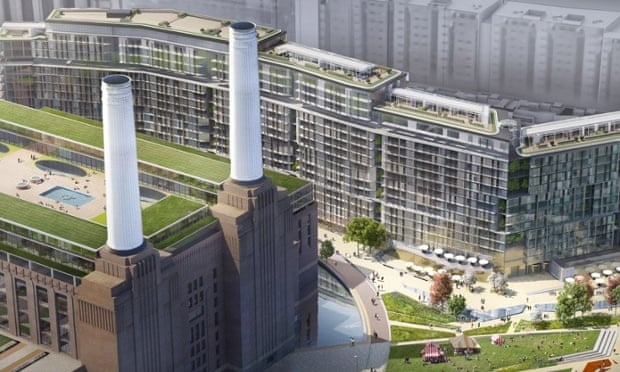
Despite multiple objections from politicians and notwithstanding Boris Johnson’s 2011 Manifesto for Public Space, the construction of Pops such as More London is continuing to escalate and expand, including nine acres planned in Tower Hamlets, a vast patch outside the Battersea Power Station development, and open space and parks at Woodberry Down near Manor House, where I was chased around for taking photos a few months ago. Given how all these developments seem to contradict stated city authority goals to increase public space that is actually publicly owned, one could be forgiven for thinking that the GLA is not actually in control of development in London.
The proposed redevelopment of Battersea Power Station will include yet more privately owned public space. Photograph: LDA Design
So what is it we expect to happen in public space? In 2008, geographer Ash Amin wrote that “public spaces marked by the unfettered circulation of bodies [produce] new rhythms from the many relational possibilities”. I experienced elements of this in the Phnom Penh National Stadium. But, when space is controlled, and especially when the public is unclear about what the legal or acceptable boundaries of activity are, we tend to police ourselves, to monitor our behaviour and to limit our interactions, especially after embarrassing confrontations with security.
Property owners are perfectly aware of this and prey on those sensibilities. The new King’s Cross development at Granary Square is one of the largest open-air spaces in Europe – about the same size as Trafalgar Square. Unlike Trafalgar Square, it is also a Pops. Photographer Nicholas Goodden set up a tripod there recently to take a photo, and was immediately asked by security whether he had a permit to do so. When he said he did not, he was ordered to move across the canal to get his image. In other words, he was kicked out of “public” space. This would not have happened to a photojournalist in Trafalgar Square, which is owned by the Crown and managed by the Greater London Authority.
Moreover, an encounter with security like this may make you wary and cause you to confine your behaviour to a narrow range so as to avoid confrontation. The psychological effects of this sort of self-policing were written about by Michel Foucault: “He who is subjected to a field of visibility, and who knows it, assumes responsibility for the constraints of power; he makes them play spontaneously upon himself; he inscribes in himself the power relation in which he simultaneously plays both roles; he becomes the principle of his own subjection.”
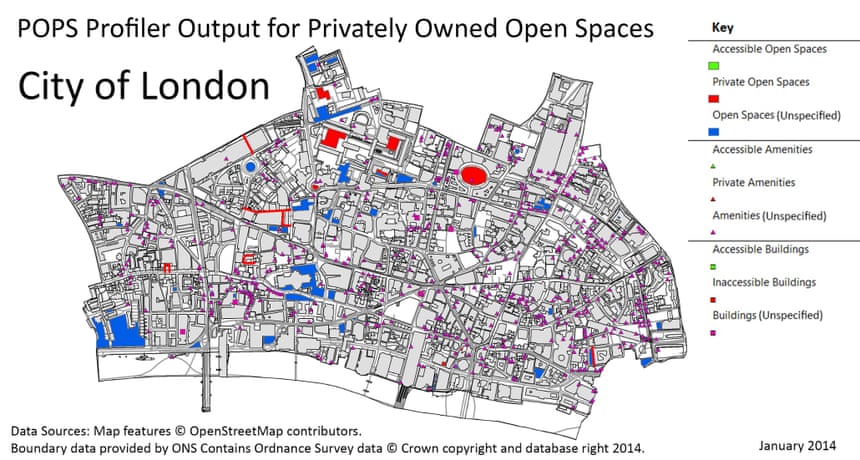
The Pops Profiler, by Casa student Oliver Dawkins, shows privately owned public space in London’s Square Mile
Geographer Don Mitchell suggests that what public space provides in a city under surveillance are small islands of freedom surrounded by Foucault’s “carceral archipelago” – the surveilled city. Herein lies a crucial question: what happens when our small islands of freedom become indistinguishable from the rest of the city? Sociologist Richard Sennett suggests that private public spaces are “dead public spaces” because the essence of conviviality, spontaneity, encounter and yes, that little sprinkle of chaos, have been stripped out. The spaces are not rendered dead because they aren’t enjoyable – I myself enjoy lounging on the steps near the canal at Granary Square – but dead because the potential range of spatial engagement here can fit in a coffee cup.
“By claiming space in public, by creating public spaces, social groups themselves become public,” Mitchell writes. “Only in public spaces can the homeless, for example, represent themselves as a legitimate part of ‘the public’.” I’m sure we can all imagine how Granary Square security might respond to a homeless Londoner making their woes public on their private AstroTurf.
The power for corporate entities to not only impede certain activities but to bar the public access to “public” space was upheld during the Occupy protest court proceedings. On 14 October 2011, an injunction passed “preventing ‘persons unknown’ entering or remaining in or trespassing on [Paternoster Square]”. While Occupy may seem like ancient history, these proceedings were important because they set a precedent: protest would not be tolerated in open-air private space.
It is no coincidence that the aforementioned Lexicon lurker deployed a tent in his bogus ad. The tent has become a powerful totem: from Brian Haw to Occupy, it symbolizes the bringing of the domestic sphere into the public, and has become so feared by authorities that Westminster City Council passed bylaws in 2012 “to regulate tents and other structures and sleeping equipment”. So much for urban camping
At a recent TEDx Southampton University event about public space in London, I suggested that the moment for direct action against the loss of public space is upon us – an action that would echo the mass trespass of Kinder Scout by the Rambler’s Association in 1932, described by Lord Roy Hattersley as “the most successful direct action in British history”. Taking action by finding and using public space sidesteps the thorny, and frankly depressing, issue of what has been lost. Instead, it focuses on what we can do.
The first hurdle, however, is that public space in London has not been mapped in any sort of systematic way. Oliver Dawkins, doing degree work at UCL’s Centre for Advanced Spatial Analysis (Casa), created a “Pops Profiler” that enables us to see how this plays out in the Square Mile. Publicly available data on Open Street Maps (OSM) do not indicate a single open space that is explicitly designated as publicly accessible (though there are many where ownership is “unspecified”). This suggests that OSM users can’t tell which open spaces are public and which are private.
Last year, when I tried to walk a section of the Thames Path with Jack Shenker and Anna Minton, we found many underutilised parts of the trail – including one that a building security guard asked for identification to access. Hostile architecture intimidates people away from access, poor signage misdirects them. What I suggest in my TEDx talk is that we should start systematically mapping out and using these public spaces to raise awareness about what we have – before we lose it.
So that’s my plan. Along the way, in a series of articles for Guardian Cities, I intend to tackle overarching questions about where public spaces are, and what they are for. I am also interested in the ways that people subvert private space by undertaking “public” acts without permission, to create what Hakim Bey calls “temporary autonomous zones”. The deployment of the tent on Lexicon Tower is a good example of that.
As an ethnographer, I am keen to approach this project from the ground up, seeking out small acts and helping to organised events in public spaces. The fundamental question for me is one of visibility. If information about public space – where it is, what we can do in it – is not clear, then small acts can reveal what is and is not possible ... which we can then map. If you have a story you would like to share for inclusion in future pieces, please do get in touch.
A recent study by urban forestry guru David Nowak and other researchers at U.S. Forest Service and The Davey Institute found that urban trees save at least one life per year in most cities and up to 8 people per year in large metropolises like New York City.
“Trees growing in cities help clean the air of fine particulate air pollution — soot, smoke, dust, dirt — that can lodge in human lungs and cause health problems,” Grist explains. As an example, “trees clear 71 tons” of air particulate matter 2.5 micrometers in diameter (PM2.5) from Atlanta’s air each year.
Urban particulate air pollution kills as many as 2.5 million people each year. PM 2.5 has a drastic effect on human health, including premature mortality. Researchers noted that larger particles between particulates 2.5 to 10 micrometers in diameter—also called coarse dust particles or PM10—are removed by trees at a substantially higher rate. However, the health benefits of PM2.5 removal is 30 to 350 times more valuable.
What happens to our health when those trees die from natural causes en masse? Apparently, as another recent study claims, people die, too. This study showed that the “loss of trees to the emerald ash borer increased mortality related to cardiovascular and lower-respiratory-tract illness. This finding adds to the growing evidence that the natural environment provides major public health benefits.” Untrammeled development would then also have the same negative health impacts at the ash borer.
Of course, the health benefits are not restricted to our lungs and heart, but also our minds. As can be seen in a new UK-wide study, parks, gardens, and even street trees in urban areas improve the mood and mental well-being of the surrounding residents.
The value of trees goes well beyond their immediate air quality-reducing properties, too. According to one recent U.S. Forest Service study, “urban forests are responsible for storing 708 million tons of carbon—a service valued at $50 billion.”
Not to ignore the financial side of better health, the Nowak study also claims that “the average health benefits value per hectare of tree cover was about $1,600, but varied [from city to city].”
The study concludes that “trees can produce substantial health improvements and values in cities.” Although more research is needed to improve these estimates, this study also leaves room for new research that explores the local effects of tree-filled landscapes in cities.
On the Boards: JBC is proud to be a part of this exciting project with the Field Operations team.
As it stands now, Chicago's Navy Pier is a cluttered, over-commercialized tourist trap that juts out into Lake Michigan. But a new redesign of the pier, unveiled by James Corner Field Operations—the firm behind New York's much-celebrated High Line—and nArchitects, calls for the transformation of Navy Pier into a lush urban park. Due to budgetary constraints, the updated plan is significantly scaled back from the plan outlined by Corner last year, but it promises to open up the pier and make it more inviting, providing sweeping views of the lake and city skyline.
Perhaps the biggest addition to the pier will be a large, curved staircase that will be flanked by a “wave wall,” providing unobstructed views of Lake Michigan and the Chicago skyline. “It will be like the Spanish Steps in Rome,” Corner told the Chicago Tribune. There is nothing remotely similar to the Spanish Steps in Navy Pier’s current formation; it’s difficult to see much of anything from the pier because the main walkways are crowded with concessions, and it’s often surrounded by large boats. Those boats will also be moved to provide clear views.
The grand staircase should at the very least provide a nice seating area from which to look out on the city and the lake. In addition to the grand staircase and wave wall, the overhaul will include plenty of new plantings throughout the pier. A new fountain for kids to splash around in, which will be transformed into an ice skating rink, will also be added. Future phases could include upgrades to the Crystal Garden, and landscape enhancements on the western side of the park. Construction is expected to begin this fall, and the first phase should be completed by summer 2015.
As the authors themselves conclude, the results really demonstrate, above all else, the salutary effects of a natural environment. "In sum, we have shown that simple and brief interactions with nature can produce marked increases in cognitive control. To consider the availability of nature as merely an amenity fails to recognize the vital importance of nature in effective cognitive functioning."
The second conclusion, more germane for our purposes, is that "incorporating nearby nature into urban environments may counteract" some of the cognitive strains placed on the brain by the city, the authors write. Recent research has suggested economic and crime benefits of urban greenery; now advocates can legitimately add "public health" to their list of arguments. Read more:
John Paulson's recent $100 million gift to New York's Central Park, the largest bequest ever to a city park, has drawn considerable praise and, surprisingly, some blowback (the old "no good deed goes unpunished" scenario). Philanthropy and public-private partnerships should not be faulted but encouraged. Read more: