Friday, May 17, 2013

Fungi May Be Able to Replace Plastics


Fungi have fantastic capabilities and can be grown, under certain circumstances, in almost any shape and be totally biodegradable. And, if this weren’t enough, they might have the potential to replace plastics one day. (Credit: Union College)

Fungi, with the exception of shitake and certain other mushrooms, tend to be something we associate with moldy bread or dank-smelling mildew. But they really deserve more respect. Fungi have fantastic capabilities and can be grown, under certain circumstances, in almost any shape and be totally biodegradable. And, if this weren't enough, they might have the potential to replace plastics one day. The secret is in the mycelia.
 
Union College Biology Professor Steve Horton likens this mostly underground portion of fungi (the mushrooms that pop up are the reproductive structures) to a tiny biological chain of tubular cells.
"It's this linked chain of cells that's able to communicate with the outside world, to sense what's there in terms of food and light and moisture," he said. "Mycelia can take in nutrients from available organic materials like wood and use them as food, and the fungus is able to grow as a result."
"When you think of fungi and their mycelia, their function -- ecologically -- is really vital in degrading and breaking things down," Horton added. "Without fungi, and bacteria, we'd be I don't know how many meters deep in waste, both plant matter and animal tissue."
 
Looking something like extremely delicate, white dental floss, mycelia grow in, through and around just about any organic substrate. Whether it's leaves or mulch, mycelia digest these natural materials and can also bind everything together in a cohesive mat. And these mats can be grown in molds, such as those that might make a packing carton.
 
Ecovative Design, in Green Island, N.Y., is harnessing this particular mycological power and is being helped by Horton, and another Union researcher, Ronald Bucinell, associate professor of mechanical engineering.
 
Ecovative uses several species of fungi to manufacture environmentally-friendly products. The process starts with farming byproducts, like cotton gin waste; seed hulls from rice, buckwheat and oats; hemp or other plant materials. These are sterilized, mixed with nutrients and chilled. Then the mycelia spawn are added and are so good at proliferating that every cubic inch of material soon contains millions of tiny fungal fibers.
 
This compact matrix is then grown in a mold the shape of whatever item Ecovative is making. Once the desired texture, rigidity and other characteristics of the product are achieved, it's popped from its mold and heated and dried to kill the mycelia and stop its growth.
 
The all-natural products, the creation of which can take less than 5 days, have no allergy concerns and are completely non-toxic. More impressive is the fact that they're also impervious to fire (to a point), and just as water resistant as Styrofoam, but they won't sit around taking up space in a landfill. They are also more UV-stable than foam since they are not petrochemical-based, and won't emit volatile organic compounds. When exposed to the right microbes, they will break down in 180 days in any landfill or backyard.
 
Mycelium is comparatively inexpensive too as it can grow on farm waste that can't be fed to animals or burned for fuel. Better yet, the fungi can be propagated without sunlight or much human oversight in simple trays at room temperature -- no immense greenhouses with costly temperature-control systems needed. It also means a smaller carbon footprint and Ecovative is hoping to the point where they can displace all plastics and foams in the market.
 
"We manipulate one strain in various ways to see if we can make versions of the fungus to suit certain applications the company has in mind," Horton said. "For example, it might be helpful if Ecovative has certain versions that grow faster."
 
Associate Professor of Mechanical Engineering Ronald Bucinell and his students also offer critical support to Ecovative's research and development pipeline. Bucinell's particular expertise is in experimental mechanics and the mechanics of reinforced materials and is tasked with seeing how strong sample material is under different parameters. This includes determining whether mycelia bind better to one plant material or another; and does the way it's treated -- with heat or something else -- make it stronger or weaker.
 
"This is a brand new field in materials, and collaboration allows us to learn a lot, and quickly," McIntyre continued. "That's really important when you're trying to replace plastics."
 

Monday, May 13, 2013

U.S. Urban Trees Store Carbon, Provide Billions in Economic Value


From New York City's Central Park to Golden Gate Park in San Francisco, America's urban forests store an estimated 708 million tons of carbon, an environmental service with an estimated value of $50 billion, according to a recent U.S. Forest Service study.
 
Annual net carbon uptake by these trees is estimated at 21 million tons and $1.5 billion in economic benefit.
In the study published recently in the journal Environmental Pollution, Dave Nowak, a research forester with the U.S. Forest Service's Northern Research Station, and his colleagues used urban tree field data from 28 cities and six states and national tree cover data to estimate total carbon storage in the nation's urban areas.
"With expanding urbanization, city trees and forests are becoming increasingly important to sustain the health and well-being of our environment and our communities," said U.S. Forest Service Chief Tom Tidwell.

"Carbon storage is just one of the many benefits provided by the hardest working trees in America. I hope this study will encourage people to look at their neighborhood trees a little differently, and start thinking about ways they can help care for their own urban forests."

Tens of thousands of people volunteered to plant and care for trees for Earth Day and Arbor Day this year, but there are opportunities all year long. To learn about volunteer opportunities near your home, visit the Arbor Day Foundation. The Forest Service partners with organizations like the Arbor Day Foundation and participates in programs like Tree City USA to recognize and inspire cities in their efforts to improve their urban forests. Additionally the Forest Service is active in more than 7,000 communities across the U.S., helping them to better plan and manage their urban forests.

Nationally, carbon storage by trees in forestlands was estimated at 22.3 billion tons in a 2008 Forest Service study; additional carbon storage by urban trees bumps that to an estimated 22.7 billion tons. Carbon storage and sequestration rates vary among states based on the amount of urban tree cover and growing conditions. States in forested regions typically have the highest percentage of urban tree cover. States with the greatest amount of carbon stored by trees in urban areas are Texas (49.8 million tons), Florida (47.3 million tons), Georgia (42.4 million tons), Massachusetts (39.6 million tons) and North Carolina (37.5 million tons).

The total amount of carbon stored and sequestered in urban areas could increase in the future as urban land expands. Urban areas in the continental U.S. increased from 2.5 percent of land area in 1990 to 3.1 percent in 2000, an increase equivalent to the area of Vermont and New Hampshire combined. If that growth pattern continues, U.S. urban land could expand by an area greater than the state of Montana by 2050.
The study is not the first to estimate carbon storage and sequestration by U.S. urban forests, however it provides more refined statistical analyses for national carbon estimates that can be used to assess the actual and potential role of urban forests in reducing atmospheric carbon dioxide.

More urbanization does not necessarily translate to more urban trees. Last year, Nowak and Eric Greenfield, a forester with the Northern Research Station and another study co-author, found that urban tree cover is declining nationwide at a rate of about 20,000 acres per year, or 4 million trees per year.

http://www.sciencedaily.com/releases/2013/05/130507195815.htm

Thursday, May 9, 2013

Will bioluminescent trees replace streetlights?

Bioluminescent Trees Courtesy Alberto T. Estevez

Imagine taking a midnight stroll, your route lit by row upon row of trees glowing a ghostly blue. If work by a team of undergraduates at the University of Cambridge pans out, bioluminescent trees could one day be giving our streets this dreamlike look. The students have taken the first step on this road by developing genetic tools that allow bioluminescence traits to be easily transferred into an organism.
Nature is full of glow-in-the-dark critters, but their shine is feeble - far too weak to read by, for example. To boost this light, the team, who were participating in the annual International Genetically Engineered Machines competition (iGEM), modified genetic material from fireflies and the luminescent marine bacterium Vibrio fischeri to boost the production and activity of light-yielding enzymes. They then made further modifications to create genetic components or "BioBricks" that can be inserted into a genome.
The team managed to produce a range of colours by putting these genes into the Escherichia coli bacterium. They found that a volume of bacterial culture about the size of a regular wine bottle gave off enough light to read by.
"We didn't end up making bioluminescent trees, which was the inspiration for the project," says team member Theo Sanderson, who is studying genetics. "But we decided to make a set of parts that would allow future researchers to use bioluminescence more effectively." The team presented its findings earlier this month at the iGEM Jamboree, held at the Massachusetts Institute of Technology.
One major obstacle to harnessing bioluminescence is that the process relies on a class of compounds called luciferins. They emit light and are then converted into oxyluciferin, which cannot produce light. To counter this, the Cambridge team found a way to engineer BioBricks that would enable organisms to produce enzymes to recycle oxyluciferin.
Bioluminescent plants could appeal especially to people whose homes are not wired up to the electricity grid. These living lights have no breakable parts, and new lights can be made simply by growing more of them. The team calculates that for a bioluminescent tree to compete with a street light, only 0.02 per cent of the energy absorbed for photosynthesis would need to be diverted into light production.
So are glowing trees coming soon to a street near you? It's unlikely, says Alexandra Daisy Ginsberg, a designer and artist who advised the Cambridge team. "We already have light bulbs," she says. "We're not going to spend our money and time engineering a replacement for something that works very well."
However, she adds that "bio-light" has a distinctive allure. "There's something much more visceral about a living light. If you have to feed the light and look after it, then it becomes more precious."

http://www.newscientist.com/article/mg20827885.000-glowing-trees-could-light-up-city-streets.html

Tuesday, May 7, 2013

What’s Trending in Sports Turf Irrigation: Q&A with Jeff Bruce


Issue Date: May ST 2013, Posted On: 4/29/2013
 If you believe irrigation consultants just know sprinkler systems, you’re way off the mark. The American Society of Irrigation Consultants (ASIC) has spent the past 40-plus years training and supporting irrigation professionals in the industry in emerging water codes and regulations, water resource development and quality, turf management, soil science, chemistry, agronomy, horticulture, business development, marketing—you get the idea.

We caught up with Jeff Bruce, ASIC immediate past president, and principal of Jeffrey L. Bruce & Company (JLB) in North Kansas City, MO. Bruce founded JLB in 1986, and has rocketed to the top of the sports turf industry since, completing about 600 professional and NCAA sports complexes in the past 10 years alone, including Alex Box Baseball Stadium at LSU, Carolina Panthers Stadium, University of Kentucky Commonwealth Stadium, and Notre Dame Athletic Complex. We asked Bruce what’s trending in sports turf irrigation. His vision of the future might surprise you—it did us.
ASIC: Tell me about the role of an irrigation consultant in overall design and management of sports fields. How has that evolved over the past decade?

JLB: Our perspective is probably a little different because we don’t just consider the playing field; we profile the entire sports complex as an integrated system. These enterprises should be completely interconnected from the bottom up; drainage, catchment, soil profile, irrigation, turf type, and so forth. Then we consider usage, safety, longevity, resilience, budget, and maintenance and management needs and capabilities. Then we look at the surrounding grounds, the plant material, the water sources, the practice facilities, the parking facilities. It’s all interrelated.
Remember that for every stadium venue there are several practice fields that are used much more intensively. Typically there are more business opportunities for those than the stadiums so we like to tie them all together.

This has evolved into a business model for us that requires a lot of specialty expertise. I’m not sure anyone else does it, but clients like managing an entire project through a single consultant.
Is it a good representation of an irrigation consultant’s role? Maybe down the road. As we see more slippage of the market—more design-build and other solutions that don’t involve just irrigation—the irrigation consultant’s role might have to expand significantly into more than effectively developing and managing water resources.

ASIC:  Any new design or business trends in athletic fields that appear to be emerging?
JLB: A couple of things. We’ve seen a shift from high-performance turf and irrigation systems to more modest projects, mostly due to restrictive budgets in this slower economy. With the popularity of artificial turf, our primary business has fallen off a bit.

Artificial turf became pretty popular in the professional ranks, and now is becoming more popular at the high school and park & rec level. More recently, however, we’re seeing an inkling of a movement back to real grass. I think it’s related to the current generation of artificial turf products. There’s really not much history or background on the performance of these newer products, and decision-makers really have to evaluate claims by manufacturers with no ability to validate them.
We’re seeing quite a few second surface replacements in fields, about every 8-10 years. Because the artificial turf safety issue is still up for debate, and certain artificial fields promote higher injury incidents, there’s a prevailing feeling that artificial turf is okay, but grass is re-emerging as the preferred surface.

There’s also been a movement to large pay-for-play facilities, like big joint county-city projects of 15-20 soccer fields where fees are charged for use. We’re starting to see the higher end of those facilities coming back to turf, as well.
So those are trends we’re experiencing. What’s to come? I absolutely believe there will be intensive new regulations in water sourcing very soon. I further expect this trend to be a great opportunity for the irrigation and sports turf industries to be a huge part of an integrated green infrastructure paradigm.

When we look toward the development of unknown irrigation technology, we see stadiums and facilities using their fields as water harvesting and water polishing enterprises, so stadium and grounds rainwater, storm water and wastewater will be collected below the sports fields, then polished in a system and reused in the facility. We’ve been looking at this for awhile.
The challenge sports turf managers have is that they’re in control of very little. Few get to decide the field or facilities they have to work with. They have to become empowered to be in position to make a difference. They certainly have the knowledge and aspirations.

These things are coming, and sports turf managers should position themselves for more control over their professional destiny.


ASIC: What about water sources? How has that evolved over the last decade? Should we be moving away from using potable water for irrigation?

JLB: Clearly, water is being subsidized; its cost still is nowhere near the cost of supplying it. There’s only one way to generate enough water for the population. Higher water rates are coming, and we’ll see dramatic increases in cost.
There remains a myopic assumption in the industry that turf managers always will have the water they’ll need. But increasingly we’re seeing big park & rec facilities that are spending a lot of money on water starting to explore developing and using alternative sources.

The high-end collegiate and professional venues don’t really think much about the cost of water; they use potable water almost exclusively. It’s cheap. But they’re starting to have storm water regulation issues, so we’re designing drainage in the fields as storage and detention basins to meet storm water requirements. There’s not a big leap of faith to move from storm water detention to harvesting water for reuse.
In the future, a prominent part of any irrigation system is going to be subsurface cisterns to secure water for irrigation, and filtration systems to render that water usable. We’ll be off the municipal water and sewer systems; off the grid entirely. I think the Green Industry is starting to understand that, as green codes continue to trend toward net-zero water. Unless the industry gets ahead of this, we’ll be walking the plank and the plank will be cutoff. We need to get off the public systems and intercept water before it gets offsite.

ASIC: What irrigation system devices most determine performance and durability in sports venues?
JLB: Sports facilities definitely offer a different perspective. We have to ensure the safety of the athletes using the facility. That absolutely affects our irrigation equipment choices.

One of the sports turf industry’s biggest challenges is that irrigation systems are falling apart because to keep costs down at the design-installation phases, piping is being undersized resulting in over-pressurized systems. We get it—irrigation is judged by upfront costs; not longer-term costs. But by small-sizing the piping, a system’s life expectancy can be cut by as much as half, and certainly opportunities for efficient water use go down.
These systems lose a lot water and turf when they fail, plus too much pressure simply deteriorates efficiency. So we’re balancing two things: throwing water a long way to keep irrigation equipment off the field, which requires higher pressures; but keeping operating pressures as low as possible to minimize physical wear on equipment. We specify larger pipe and head sizes so velocities are reduced, and wear and tear are minimized. That’s one key to extending the irrigation system’s life. It absolutely requires some salesmanship.

Another component for consideration, particularly in sports fields, is controller systems. They’re almost too sophisticated. Oftentimes the features the average controller provides are way overdone.
We like to keep it simple. Today’s groundskeepers need more diagnostic tools than features. For example, moisture content is incredibly valuable information. There’s an opportunity for turf managers to employ more moisture sensing technology in their management toolbox. Fixed or portable, they provide a quantitative measure of soil moisture content for more effective water management.

ASIC: What are your best design components, from irrigation control systems to sprinkler heads to piping and quick-couplers to pressure regulation to soil prep?
JLB: We find a full range of equipment in manufacturers’ catalogues to solve most any specific problem. If you have high pressure, then pressure regulation is important at every stage, from mains to laterals. Using pressure gauges helps you identify spikes and better understand your system.

Isolation valves reign king. Although considered a luxury by some, the ability to isolate sections of a loop system in the event of a breach saves time, turf and equipment. Strategically placed isolation valves can be a manager’s best friend in a crisis. It’s important.
And then there are the smaller details, like accessing quick couplers for spot watering or syringing; or using quality swing joints instead of funny pipe. Not every solution is a big, impressive piece of equipment. High-performance systems should include all arrows in your quill to maintain a performance-tuned operation. Certainly stainless steel risers are important on sand-based facilities.

Use the irrigation manufacturers’ catalogue for distinct benefits that address system or site idiosyncrasies. There truly is a piece of equipment for every potential problem.
When you look at big sports complexes, the upfront cost of irrigation equipment is really pretty small compared to the cost of maintaining the fields themselves. It seems short-sighted to save $100 on a cheaper controller, but pay someone $25 an hour to adjust the runtimes. You might save that hundred bucks up front, but shell out $30,000 over a 20-year period. We need to be more sophisticated in our cost evaluations.

ASIC: Do you work off a template you’ve developed over the years or is every ball field project so unique that you start from scratch?
JLB: For years we would design irrigation for a stadium thinking it looked like the previous stadium. So we’d pull out our old project plans and specifications, and tweak them.  We realized at some point that each facility just became its own project. There’s ample uniqueness to sports fields and facilities that we have to start from scratch with each one. And it’s not just the quirkiness of the sites; turf managers also are unique in their management needs and preferences.

Most fields are used a number of different ways, so the parameters change with each project. There are different needs for lacrosse, than football, than soccer, than rugby, than concerts, than car shows. Different uses are going to affect the overall design.
Luke Frank is a freelance writer who submitted this article on behalf of the American Society of Irrigation Consultants, www.asic.org. Source: www.sportsturfonline.com/ME2/Audiences

Saturday, May 4, 2013

Cities of the Future: Built By Drones and Bacteria


By Chris Arkenberg
As scientists make huge strides in robotics, natural building materials, and new construction methods, our urban architecture could take on a much different form than the rigid construction we’re used to. As complex ecosystems, cities are confronting tremendous pressures to seek optimum efficiency with minimal impact in a resource-constrained world. While architecture, urban planning, and sustainability attempt to address the massive resource requirements and outflow of cities, there are signs that a deeper current of biology is working its way into the urban framework.
Innovations emerging across the disciplines of additive manufacturing, synthetic biology, swarm robotics, and architecture suggest a future scenario when buildings may be designed using libraries of biological templates and constructed with biosynthetic materials able to sense and adapt to their conditions. Construction itself may be handled by bacterial printers and swarms of mechanical assemblers.

“Buildings may be designed using libraries of biological templates and constructed with biosynthetic materials.”

 Much of the modern built environment we experience began its life in CAD software. In the Bio/Nano/Programmable Matter lab at Autodesk Research, engineers are developing tools to model the microscopic world. Project Cyborg helps researchers simulate atomic and molecular interactions, providing a platform to programmatically design matter. Autodesk recently partnered with Organovo, a firm developing functional bioprinters that can print living tissues. This pairing extends the possibilities from molecular design to biofabrication, enabling rapid prototyping of everything from pharmaceuticals to nanomachines.
Tools like Project Cyborg make possible a deeper exploration of biomimicry through the precise manipulation of matter. David Benjamin and his Columbia Living Architecture Lab explore ways to integrate biology into architecture. Their recent work investigates bacterial manufacturing--the genetic modification of bacteria to create durable materials. Envisioning a future where bacterial colonies are designed to print novel materials at scale, they see buildings wrapped in seamless, responsive, bio-electronic envelopes.
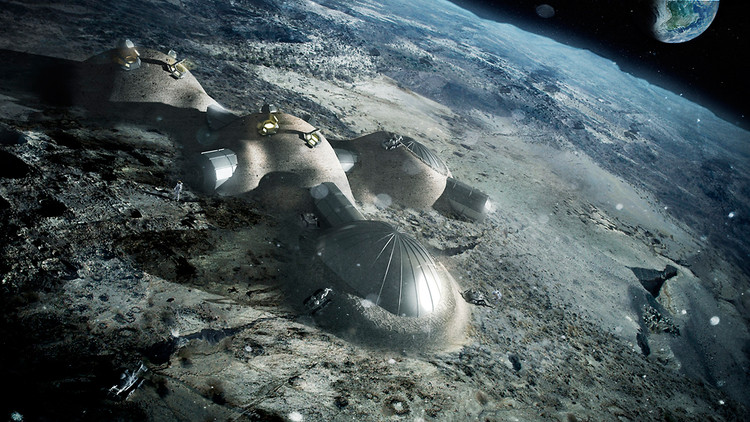
From molecular printing to volume manufacturing, roboticist Enrico Dini has fabricated a 3-D printer large enough to print houses from sand. He’s now teamed up with the European Space Agency to investigate deploying his D-Shape printer to the moon in hopes of churning lunar soil into a habitable base. Though realization of this effort remains distant, it’s notable to show how the thinking--and money--is moving to scale 3-D printing well beyond the desktop.
 

While printers integrate new materials and scale up to make bigger things, another approach to construction focuses on programming group dynamics. Like corals, beehives, and termite colonies, there’s a scalar effect gained from coordinating large numbers of simple agents towards complex goals.
The Robobees project at Harvard is exploring micro-scale robotics, wireless sensor arrays, and multi-agent systems to build robotic insects that exhibit the swarming behaviors of bees. They see a future where “coordinated agile robotic insects” are used for agriculture, search and rescue, and (of course) military surveillance. Taking a cue from mound-building termites, the TERMES project is developing a robotic swarm construction system. The team is working to get cooperative robots building things bigger than themselves by mapping the rules underlying emergence in autonomous distributed populations. Mike Rubenstein leads another Harvard lab, Kilobot, creating a “low cost scalable robot system for demonstrating collective behaviors.” His lab, along with the work of researcher’s like Nancy Lynch at MIT, are laying the frameworks for asynchronous distributed networks and multi-agent coordination, aka swarm robotics.
All of these projects are brewing in university and corporate labs but it’s likely that there are far more of them sprouting in garage shops and skunkworks across the globe. They each recapitulate the efficiency and conservation of natural systems through the convergence of biology and computation. Looking at the threads of algorithmic chemistry, bacterial manufacturing, and swarm robotics, and refracting them through our resource constraints, environmental degradation, and human security, we can develop some intriguing scenarios for the future.

“Within a decade or so, the barriers between biology and technology will start to fall."

 Assuming a fairly linear scenario, the next decade should show steady progress in molecular modeling, yielding more breakthroughs in designer bacteria, nanosystems, and the hybridization of organic and inorganic materials. The software stack for algorithmic chemistry and synthetic biology will start to formalize, enabling better collaboration around libraries of biosynthetic design patterns. Additive printers will evolve to meet the demands of manufacturing at both volume and scale. Deployment of 3-D printers into the field for maintenance, disaster relief, and remote engineering projects will further drive their development.
Within a decade or so, the barriers between biology and technology will start to fall. At the atomic scale, nanosystems will bridge organic and inorganic structures while biologists engineer rudimentary cellular computers and bacterial printers. At the macro scale, robotic swarms will become more sophisticated, with the steady integration of bio-physiology into their mechanics, lifted by lightweight sensors and the rules underlying autonomy and multi-agent coordination.
Further out on the horizon, this scenario means a greater coupling of biosystems and computation to evolve the living city. Bacteria will be engineered to target specific materials, like aging concrete. Released into cities, they will replace the old stuff with new bacterial glue that’s structurally sound, networked, and computational. Other bacteria could perform similar maintenance by retrofitting aging utility conduits and faded solar skins. Protocell computers could also be released into ecosystems, sensing chemical properties and transmitting them on mesh networks to remote dashboards. Vats of bacteria will pump out fuels, protein resources, and water.

 “Architecture will lose its formal rigidity, softening and flexing and getting closer to the life we see in plants."

 Future architects will work in modeling systems that stream biotemplates into their designs, solving for resource dependencies by ecosystem mapping in simulated environments. Their designs will exploit responsive meta-materials to confer sensing and adaptation to biomimetic curtain walls and building envelopes that flex and fold, opening and closing pores based on environmental conditions and population movements. Fleets of swarm constructors will assemble special scaffolding that guide bacteria specialized to grow the bones of the building, the vasculature, and the skin through which secondary swarms will plumb utilities. Printers will churn out conditioning systems and appliances and furnishings in adaptive materials. Architecture will lose its formal rigidity, softening and flexing and getting closer to the life we see in plants.
These vignettes are merely suggestive of how things may unfold from current trends. But the steady convergence of biology and computation will inevitably guide our hands to more closely align with natural systems. Precision design of programmable matter and a robust environment for simulation and rapid prototyping will reveal entirely new kinds of materials to build the world of tomorrow.
http://www.fastcoexist.com/1681891/cities-of-the-future-built-by-drones-bacteria-and-3-d-printers

Friday, May 3, 2013

Chicago’s ‘Greenest Street’ Uses Smog-Eating Cement

A solar- and wind-powered energy station and a bioswale are seen on West Cermak Street in Chicago. Image via Phys.org.

by Randy Woods 
In a city better known for turning its rivers bright green every March 17, a new title has been bestowed upon an unassuming little stretch of pavement in the industrial Pilsen section of Chicago. Two miles of West Cermak Road have been ceremoniously dubbed by the city as “the greenest street in America” for the long list of sustainable features lurking under and around the pavement.

While this is obviously just a little more wind from the Windy City (a million dirt roads anywhere in the world are far greener), the technology embedded in the $14 million stretch of pavement in front of Chicago’s Benito Juarez Community Academy looks promising enough to make a difference if it’s scaled up to an entire neighborhood.

First of all, the permeable pavement itself contains concrete created by Italcementi, the Italian manufacturer of “smog-eating cement,” which has been used on some buildings to resist discoloration. The cement contains titanium dioxide, which reacts with sunlight to speed up decomposition of any organic materials that build up on the surface. Tests have shown that the material actually helps clean the air as far away as eight feet from its surface.

The areas surrounding the pavement are equally impressive. On both sides of the street, bioswales have been added to absorb as much as 80 percent of storm water before it has a chance to overwhelm the sewer system. The drought-resistant trees, shrubs and grass in these bioswale belts are expected to withstand Chicago’s hot summers. They also consume CO2 and reduce the heat-island effect of paved surfaces.

Streetlamps are also lit by stored energy generated from a combination of solar panels and small windmills that are cleverly contained with slender energy kiosks sticking up from the sidewalks. Dedicated bicycle lanes have also been added to encourage non-polluting commuting. About 60 percent of the project’s construction waste was recycled and 23 percent of the new materials used contained recycled content.

According to the Chicago’s Office of Environment and Sustainability, the $14 million project cost 21 percent less than a traditional road resurfacing project and is expected to have fewer maintenance costs. The city said it is currently working on guidelines that may require many of these affordable green features to be included in all future road projects.

Wednesday, May 1, 2013

Robotic Bees to Pollinate Monsanto Crops

by Russ McSpadden / Earth First! NewswireScreenshot_1
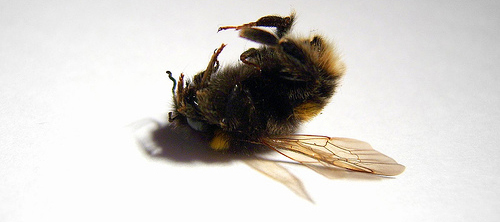
Pollinators participate in the sexual-reproduction of plants. When you eat an almond, beet, watermelon or sip on coffee, you’re partaking of an ancient relationship between pollinators and flowers. But since the 1990s, worldwide bee health has been in decline and most evidence points to toxic pesticides created by Shell and Bayer and the loss of genetic biodiversity due to the proliferation of GMO monocrops created in laboratories by biotech companies like Monsanto.
But never worry, those real life pollinators—the birds and the bees, as they say—may soon be irrelevant to the food needs of civilization. Harvard roboticists are developing a solution to the crisis: swarms of tiny robot bees made of titanium and plastic that can pollinate those vast dystopian fields of GMO cash crops.

The Harvard Microrobotics Lab has been working on its Micro Air Vehicles Project since early 2009. Borrowing from the biomechanics and social organization of bees, the team of researchers is undergoing the creation of tiny winged robots to fly from flower to flower, immune to the toxins dripping from petals, to spread pollen. They even believe that they will soon be able to program the robobees to live in an artificial hive, coordinate algorithms and communicate amongst themselves about methods of pollination and location of particular crops.  
Of course, published reports from the lab also describe potential military uses—surveillance and mapping—but the dime-sized cyber-bees have yet to be outfitted with neurotoxin tipped stingers.
dead-bee